White Paper

Why FERC Order 881 Success Depends on FAC-008 Discipline

Additional transmission capacity depends on the limits of every component in the circuit, including substation equipment. Applying NERC FAC-008 facility ratings practices helps utilities account for those constraints as they implement FERC 881.


The electrical transmission grid faces unprecedented demands, requiring transmission owners to maximize throughput across existing transmission corridors. New high-voltage lines often require up to a decade of permitting and construction, so the industry has turned its focus toward operational efficiency and dynamic line capacity.

At the center of the operational efficiency and dynamic line capacity transition is Federal Energy Regulatory Commission (FERC) 881. The rule mandates that transmission providers implement ambient adjusted ratings (AARs) for all transmission lines affected by ambient air temperature. Under Order 881, utilities must calculate hourly ratings across four distinct seasons, adjusting transfer capabilities in temperature increments of 5 degrees Fahrenheit or less.

Many organizations view Order 881 primarily as a software and data integration challenge in which they must connect temperature forecasts to energy management systems (EMS) and publish updated lookup tables to adjust transmission line equipment. This perspective carries significant risk because an AAR calculation is only as reliable as the baseline engineering data beneath it. If a utility applies dynamic line algorithms on top of flawed static assumptions, unmodeled legacy construction or degraded substation terminal equipment, the results could include physical asset damage and severe regulatory exposure under North American Electric Reliability Corp. (NERC) Reliability Standard FAC-008.

Increasing a transmission line’s rating does not increase the capacity of every component connected to it. If substation terminal equipment has a lower applicable rating, it constrains the circuit’s capacity. NERC FAC-008 requires the facility ratings methodology to account for the most limiting applicable equipment rating, making those substation constraints central to implementing FERC 881.


Read More  

Building an Audit-Defensible Facility Ratings Methodology

Every operational transmission rating begins with NERC Reliability Standard FAC-008 Requirement R3, which mandates a documented facility ratings methodology (FRM). The FRM establishes the technical and mathematical framework that governs how equipment thermal capabilities are determined across the bulk electric system, relying on established standards such as IEEE Standard 738 for conductors, the IEEE C37 series for switchgear and the IEEE C57 series for transformers.

The methodology must document explicit environmental assumptions, including defined ambient temperature baselines, solar flux tables and wind speed criteria, as well as continuous and short-duration emergency ratings. Without clear mathematical justification for how these baseline static ratings are established, any dynamic rating layered over them becomes indefensible. An effective ratings methodology involves a set of rigorous, repeatable processes established to confirm that the underlying data sources used for calculations are accurate. Utilities must first verify that they are calculating ratings for the correct equipment in the field.
Static Equipment Meets Dynamic Line Ratings

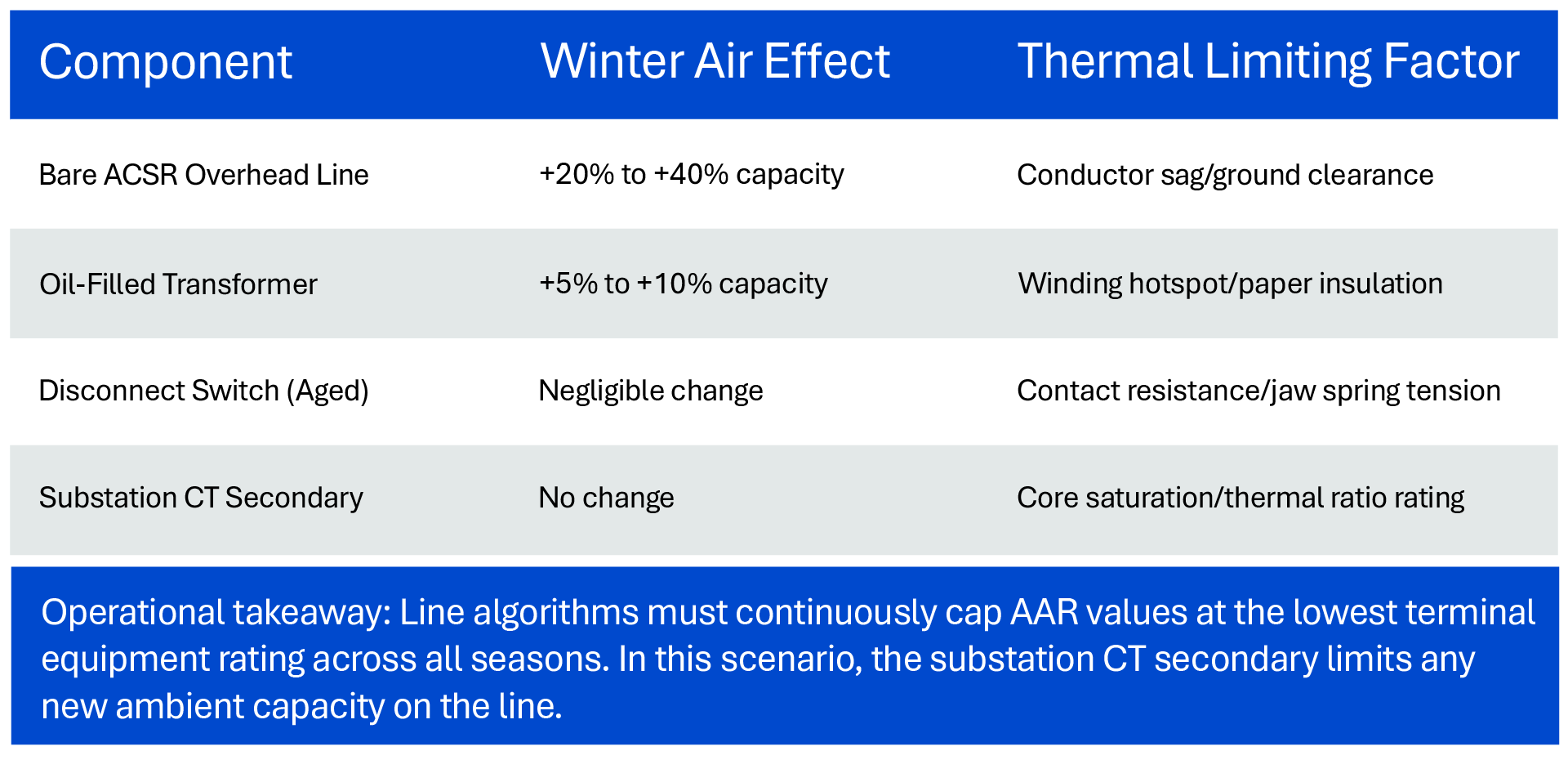
The intersection of static terminal equipment limits and dynamic transmission line ratings is where physical risk escalates under FERC 881.

Ambient adjusted ratings leverage the physics of bare overhead conductors. Because overhead lines hang in open air, dropping ambient temperatures and minor wind currents rapidly dissipate heat. In subfreezing winter weather, a standard aluminum conductor steel-reinforced (ACSR) line can safely carry 20% to 40% more current than its static summer rating without exceeding maximum sag limits.

Substation terminal components behave differently:

  • Enclosed equipment, such as circuit breakers and metal-clad switchgear, do not experience cross-wind cooling. At low temperatures, breaker heaters keep temperatures at a minimum threshold making ambient adjustment calculations inapplicable.
  • Power transformers have long thermal time constants. Their internal windings are insulated by thousands of gallons of oil, slowing ambient heat dissipation.
  • Secondary protection components, including current transformers (CTs) and relay wiring, have fixed thermal saturation limits that remain constant regardless of ambient air temperature.

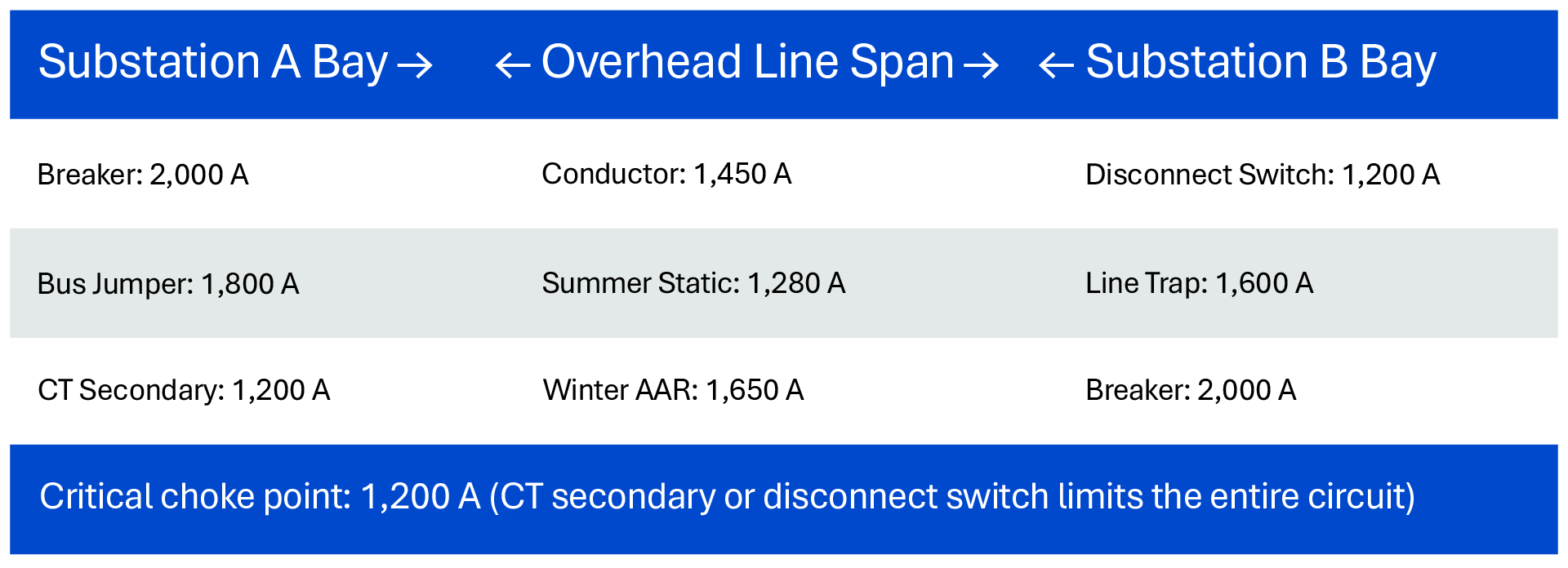
If an automated market system or system operator observes a line rating increase from 1,200 amperes to 1,600 amperes on a cold day and dispatches power accordingly, the overhead line will operate within limits. However, if that circuit passes through a substation disconnect switch with degraded contacts or an unmodeled 1,200-ampere terminal jumper, that terminal component will become severely overloaded.

Figure 1: Thermal behavior under AAR.

To prevent equipment failure and service interruptions, FERC 881 compliance systems must incorporate terminal equipment constraints directly into dynamic rating lookup engines. The dynamic rating algorithm must continuously cap the circuit's capacity at the lowest static equipment rating, regardless of how cold the outside air becomes.

Legacy Construction and the Field-to-Database Divide

Even a mathematically rigorous FRM fails if it is disconnected from physical reality in the substation yard. FAC-008 consistently ranks among the most violated reliability standards across the industry, primarily due to discrepancies between central asset databases and field conditions.

The most prevalent pitfall is focusing solely on overhead transmission conductors while ignoring substation hardware. A circuit's rating is dictated by its most limiting series component(s), which are used to determine the seasonal normal and emergency rating limits. In practical utility audits, the is frequently an overlooked secondary component inside the substation, such as an undersized CT ratio, an obsolete line trap, a station bus jumper or an undersized disconnect switch.

Figure 2: Identifying the most limiting series component.

This vulnerability frequently hides in the transition spanning between disciplines. Because transmission line inspections often terminate at the substation dead-end structure and substation walkdowns focus on major equipment, the terminal slack span or take-off jumper falls into an unmonitored blind spot.

If past through-faults, improper stringing or wind-induced vibrations cause conductor 'bird-caging' on this entry drop, the separating aluminum strands concentrate current into the remaining core. While the EMS models the incoming line as having elevated winter capacity under FERC 881, this damaged entry conductor inside the fence line becomes an unmodeled bottleneck susceptible to severe localized overheating and premature annealing. Even these physical considerations can be undermined if that conductor has been modeled incorrectly due to inaccurate legacy records.

This vulnerability is compounded by unmodeled legacy construction. Over a 50-year operating lifespan, substations experience emergency repairs, temporary bus reconfigurations and minor line tap additions. An emergency field crew in 1985 might have replaced a damaged conductor jumper with whatever wire was available in the maintenance truck. If that temporary repair was never recorded on official engineering drawings or uploaded to the enterprise asset management system, it remains an invisible weak link.

When transmission planners pull records from the database, they see a 1,500-ampere line; in the yard, that circuit is constrained by a forgotten 1,000-ampere jumper. Dispatching power based on unverified database records can overheat that unmodeled connection, resulting in burned jumpers, equipment dropouts and unplanned outages.

Accounting for Physical Degradation

Operating aged equipment under the elevated loading permitted by FERC 881 introduces specific physical risks that alter the thermal and electrical characteristics of these devices over time. Physical degradation in multiple ways, including:

  • Disconnect switches. Contact oxidation, pitting and loss of jaw spring tension increase electrical contact resistance, driving up localized heating (I²R).
  • Power transformers. Thermal stress and moisture degrade cellulose paper insulation, reducing mechanical strength and lowering the degree of polymerization (DP) index.
  • Legacy oil circuit breakers. Carbonization from operations and moisture absorption lower oil dielectric strength, while contact assemblies lose spring tension.

To mitigate these risks, a modern FRM must define condition-based derating factors that link physical field measurements directly to rating database adjustments.

Defending Aged and Legacy Assets During an Audit

To build an audit-defensible program around aging and legacy assets, utilities must move away from informal engineering judgments and establish rigorous, documented change control. This defense rests on three pillars:

  • Codified FRM thresholds. Codifying objective diagnostic triggers directly within the written FRM.
  • Unbroken data lineage. Demonstrating an unbroken data lineage from field construction and maintenance updates to the active facility ratings used by the utility's EMS.
  • Legacy equipment governance. Establishing a standardized, conservative engineering protocol to handle missing or weathered manufacturer nameplates, legacy installations, and unmodeled older equipment.
Strategic Road Map for Utilities

Transmission owners can support FERC 881 implementation and NERC FAC-008 compliance by updating their facility ratings methodology to document environmental parameters and condition-based derating rules. Targeted substation field walkdowns within critical facilities can verify equipment nameplates and identify undocumented construction. A coordinated change control process involving maintenance, engineering and compliance teams can prompt a ratings review whenever equipment is modified or replaced.

FERC 881 represents a major advancement in transmission line utilization, providing the power industry with an operational tool to relieve transmission congestion and integrate new resources. However, dynamic line rating algorithms cannot operate safely in a vacuum. By establishing rigorous engineering baselines, verifying physical field construction and managing the reality of aging substation assets under NERC FAC-008, utilities can protect system reliability and satisfy regulatory audits while unlocking grid capacity with confidence.

Putting FAC-008 discipline into practice takes reliable data and a consistent ratings process. FaciliRate helps utilities manage equipment data, automate ambient-adjusted rating calculations and create compliance reports. Learn more about the platform. https://www.burnsmcd.com/facilirate


Author

Janelle Cruz, PE

Janelle Cruz, PE

Staff Electrical Engineer