
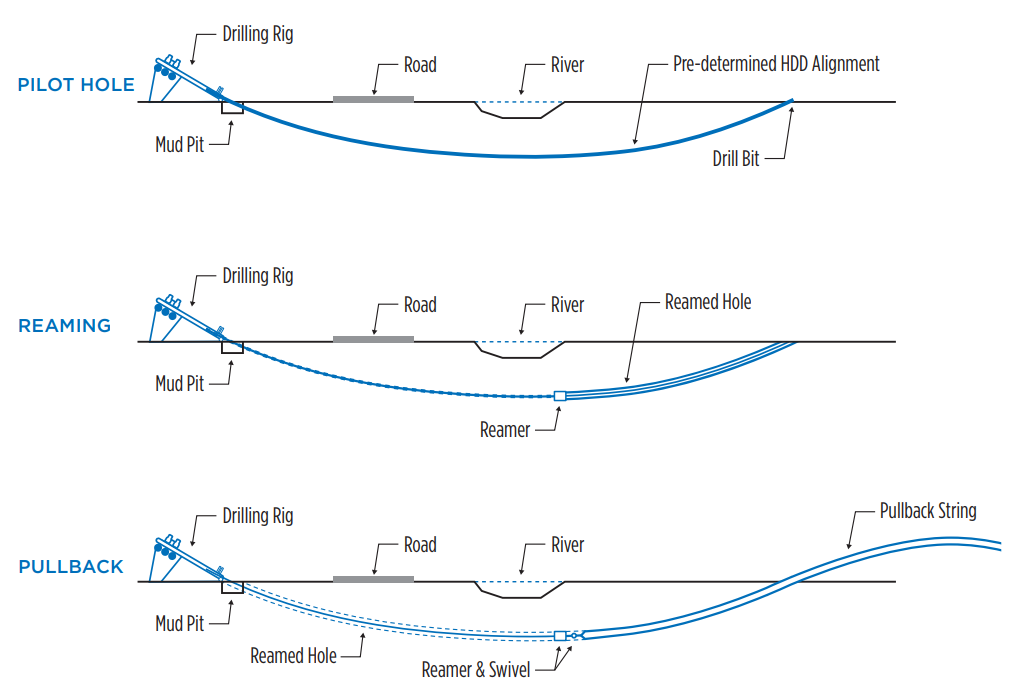
FIGURE 1: HDD process.
FIGURE 1: HDD process.
HDD is primarily used for installing utilities (electrical, natural gas, oil, water and wastewater) across rivers, large water bodies, roads, railroads, congested utility corridors and other sensitive areas where conventional trenching poses challenges. This method has higher upfront costs (material and installation) compared to the conventional pipe installation technique, but it is more common in areas where trenching can be an undesirable option or might be prohibited.
Given the higher total installed cost for HDD, a feasibility evaluation can help assess the suitability of using HDD and demonstrate the value proposition. There are several parameters that are considered while evaluating the feasibility of any HDD project.
Installation type: Understanding the type of installation, whether it is a transmission or distribution line, helps in defining the pipe size and specification. Transmission lines typically require mid or large size pipe diameter (typically 12 inches or larger), whereas most distribution lines use a smaller size pipe diameter (typically less than 12 inches). A steel pipe is the common carrier pipe for oil and gas projects; however, polyethylene (PE) or PVC pipe is often preferred for electric, water and wastewater utilities.
Obstructions: This involves identifying any significant and sensitive obstructions being crossed, such as streams, rivers, water bodies, wetlands, environmentally sensitive areas, railroads, major highways or existing utility corridors. Some of the obstructions, such as railroads, navigational waterways or levees, prohibit any trenching and mandate the use of the HDD technique. Often, several obstructions are grouped in a single crossing to optimize the design.
Geology: Geological formation is the biggest factor playing into the success of the project, and it can derail the project budget and/or schedule regardless of an appropriate design. Therefore, it is imperative to identify the local geology using available published data and consider how it would impact the HDD in the initial stages. Geological formation varies from place to place, for example, in the northeastern states of the United States, bedrock is prevalent, whereas in Southern states, alluvial deposit is more common near the coast.
Constraints: It also helps to know various constraints, such as accessibility issues, workspace issues or permitting-related restrictions that could affect the HDD installation.
Noise mitigation: This is a unique concern that is often overlooked and can have an adverse impact on the project budget and schedule if not evaluated early in the design stage. Surveying the surrounding areas, evaluating and understanding the magnitude of the noise generated from the site and potentially installing temporary sound barrier walls can drastically ease the noise levels and assist in adhering to the local noise ordinances.
A comprehensive feasibility report is prepared after evaluating all the concerns and a recommendation is made to either proceed into the detailed design phase or evaluate an alternate route for the pipeline installation.
After the HDD design feasibility evaluation is performed and the route is selected, the process moves into the detailed design phase. There are some additional factors that are considered in the detailed design stage.
Site conditions: Reconnaissance is performed to understand the physical aspects of the proposed crossing and identifying site features such as:
Workspace and accessibility: Providing adequate space for contractors is important to allow them to work efficiently and safely at the site. Typically, the diameter of the product pipe and length of the crossing determines the size of the drilling rig, drilling mud recycling system and ancillary equipment. Usually, a large entry and exit workspace is required for larger HDD drills, but a smaller entry and exit workspace is sufficient for medium- to smaller-size drills. The pipe stringing area must be appropriately sized so the contractor can prepare the pipe string in one section. This eliminates the necessity of stopping the pipe during pullback to perform a weld. Figure 2 provides more information on the recommended workspaces. Access roads should be identified and evaluated in the early design stages for proper ingress/egress at the entry and exit sites. Any necessary upgrades or modifications should be proposed for the access roads to allow the construction equipment to navigate safely.
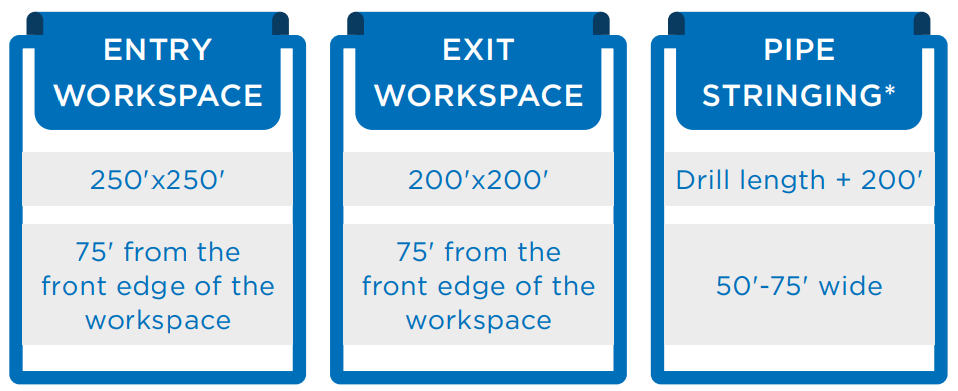
*Pipe stringing area should be designed to avoid any point of inflection (PI) or curvature. In case of a PI, a temporary workspace should be acquired to prepare the pipe string in a straight section.
FIGURE 2: Best practices for HDD workspace.
Permits: It is vital to prepare and apply for the necessary permits while designing the HDD to avoid any construction delays. A drill path across environmentally sensitive features might take several months to get approval, so it is advisable to start coordination with the jurisdictional authorities in the early stages of the HDD design.
Geology: During the feasibility stage, geological information collection is typically limited to published data from previous projects or online resources such as U.S. geological maps or USDA soil survey. However, detailed design requires a site-specific geotechnical investigation to gather the required soil information for designing the crossing while understanding the risks posed by geology. This investigation requires preparing a geotechnical scope of work, which determines the number of soil borings including their location and depth, geotechnical investigation methods for various soil types, and required testing parameters for completing the HDD design. Figure 3 highlights some of the best practices related to the soil boring location, depth and offset from the proposed alignment.
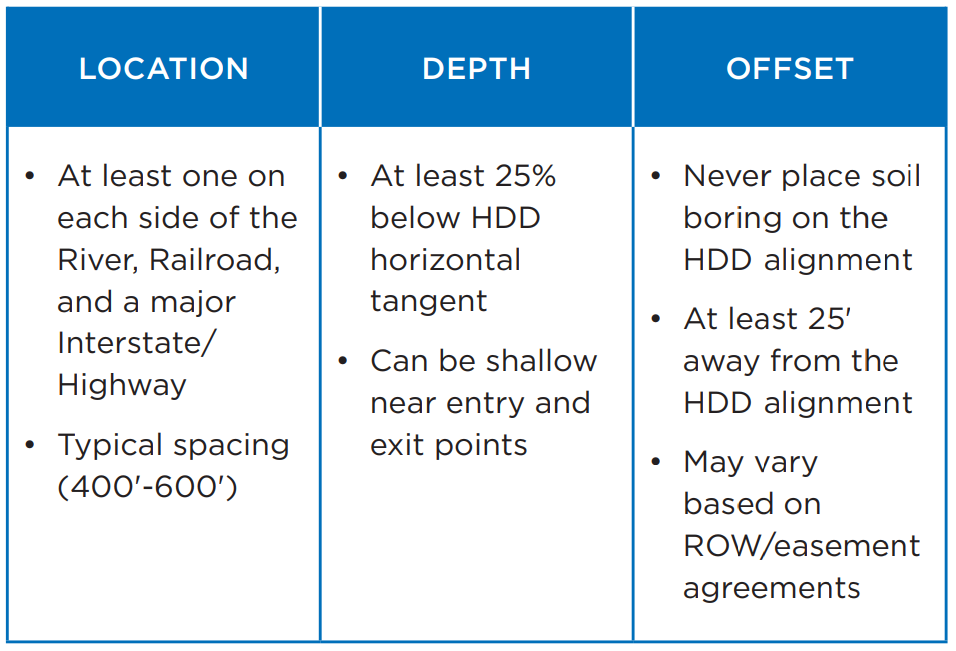
FIGURE 3: Best practices for soil boring location and depth.
The project design should take into consideration when bedrock, coarse/granular material, including any gravel, cobbles or boulders, is found during the geotechnical investigation.
Geometry: The preliminary geometry is refined to adjust the natural ground profile and HDD alignment after a topographic survey is performed. The soil boring logs from the geotechnical investigation are also incorporated into the HDD drawing to determine the HDD elevation with respect to the soil stratigraphy.
Inadvertent return (IR) analysis: The IR is defined as an unintentional migration of drilling liquids to the surface during the drilling process. An IR analysis is performed to identify and eliminate IR risks across the crossing. Final design adjustments are made based on the results of the IR analysis, such as increasing the depth or choosing a specific soil strata for the HDD alignment to pass through to minimize the risk of an IR.
Stress analysis: A stress analysis is performed to determine whether the proposed pipe can withstand the installation and operational stresses while complying with the code requirements. Stresses are typically calculated using the following standards and references:
The success of any HDD project largely depends on the technical feasibility of the crossing. However, the economical and contractual aspects are equally important to determine the overall impact of utilizing HDD technique on the project’s budget and schedule.
Technical feasibility entails a thorough analysis of design and engineering factors such as installation type, obstructions, geology, geometry and accessibility of the project site. In contrast, determining economic feasibility requires establishing a baseline cost to install the crossing using the HDD technique. A comparative cost analysis is performed to weigh the total installed cost of the proposed crossing against other feasible methods to determine the overall impact on the project cost. Contractual feasibility requires determining the risks associated with the HDD installation and providing the utility or pipeline operator an opportunity to address those risks prior to construction.
Usage of the HDD technique has grown tremendously in the last two decades, especially for installing pipes and cables underground where open trenching cannot be used. However, the answers to feasibility questions demand extensive research to accurately assess the technical and economic aspects of the project to making cost-effective and defensible decisions.


