White Paper

Rethinking the Value of Combined-Cycle Conversions for More Megawatts

Not long ago, converting a simple-cycle natural gas plant to combined-cycle operation was often difficult to justify economically. Although a retrofit could increase electricity output and improve efficiency, the added value often did not offset the conversion cost — particularly compared with building a new combined-cycle plant. But as electricity demand grows and infrastructure constraints tighten, such retrofits may offer a viable way to increase power output without requiring a corresponding expansion of pipeline capacity.


With electricity demand growing, the power sector must add dependable generating capacity and make it available where and when it is needed.

Natural gas is expected to play a significant role in meeting this demand. It already supplies roughly 40% of U.S. electricity generation, according to the U.S. Energy Information Administration (EIA), and remains central to reliable, affordable power.

Looking ahead, EIA projects natural gas use in the power sector will rise from 35.2 Bcf/d in 2025 to between 38.1 and 50.4 Bcf/d by 2050 in most modeled scenarios, an increase of about 8% to 43%, depending on the scenario. Meeting that growth will require more than moving additional volumes of gas; pipelines must also be able to deliver it to generators as power-sector demand changes.


Read More  

The Infrastructure Challenge

The U.S. pipeline network was designed for predictable, ratable flows, while gas demand from power generators can change sharply. That matters because, on a constrained pipeline, additional firm transportation generally requires either freeing up existing capacity or expanding the system through additional compression, a parallel pipeline loop, or replacement of a segment with larger-diameter line.

In practice, gas-fired generators face three distinct fuel-delivery risks:

  1. Pipeline capacity can be so constrained in some regions that generators may be unable to secure firm transportation. On the Texas Eastern (TETCO) and Algonquin systems, for example, power generators’ winter peak gas demand over the past three years was roughly eight and six times their contracted mainline capacity respectively, according to a 2025 National Petroleum Council report. Many of these generators therefore rely on secondary capacity and remain vulnerable to curtailment.
  2. Delivery flexibility can become a constraint. During Winter Storm Elliott on the East Coast in 2022, generators that relied on interruptible service were unable to obtain gas quickly enough to meet steep increases in electricity demand. Several major Eastern interstate pipelines restricted gas flows as the supply already in their pipelines was depleted, limiting their ability to respond to sudden power-sector needs.
  3. Supply disruptions can originate upstream, before gas reaches the pipeline. Extreme cold has caused wellhead freeze-offs and disruptions at gathering and processing facilities, reducing gas production and limiting the amount of fuel available to the pipeline system.

Together, these constraints make the economics of new generation site-specific. A region may have abundant natural gas, yet the pipeline serving a proposed plant site may lack the capacity to provide firm transportation. Securing additional firm service or expanding the pipeline typically raises the delivered cost of gas and can delay the project’s ability to get online.

Owners of existing simple-cycle plants with established gas connections may have another option. By converting the plants to combined-cycle operation, they can increase output without a comparable expansion in gas-delivery capacity.
Rethinking the Gas Plant Playbook

For the last couple of decades, simple-cycle gas turbines have been the preferred way for utilities and independent power producers to add reliable generation quickly and at relatively low cost. Their operational flexibility makes them particularly well suited to meeting peak demand and complementing variable renewable generation.

The traditional case for simple-cycle turbines, however, depended in part on the availability of relatively inexpensive gas, adequate pipeline capacity and readily developable sites. Because those conditions now can vary significantly from one location to another, owners are taking a fresh look at how best to add generation, including whether existing turbines can be converted to combined-cycle operation.

Like a simple-cycle gas turbine, a combined-cycle configuration burns natural gas to generate electricity. But it then takes an additional step, capturing the exhaust heat to generate additional electricity, which lowers the overall heat rate. Combined-cycle units generate approximately 45% to 55% more power, on average, than simple-cycle units from the same fuel input and without a proportional increase in pipeline demand.

Despite the efficiency improvement they deliver, owners historically gave little consideration to combined-cycle conversions as a means of increasing generation. That’s because conversions require substantially greater upfront investment per megawatt, and when gas prices are low, the additional megawatts may not generate enough value to justify the cost. Conversion projects also have not necessarily offered a significant schedule advantage over new simple-cycle projects.

Changing Combined-Cycle Economics

As demand for reliable power grows and as it becomes harder to secure suitable sites, gas supply and pipeline capacity, the economics of combined-cycle conversions are changing.

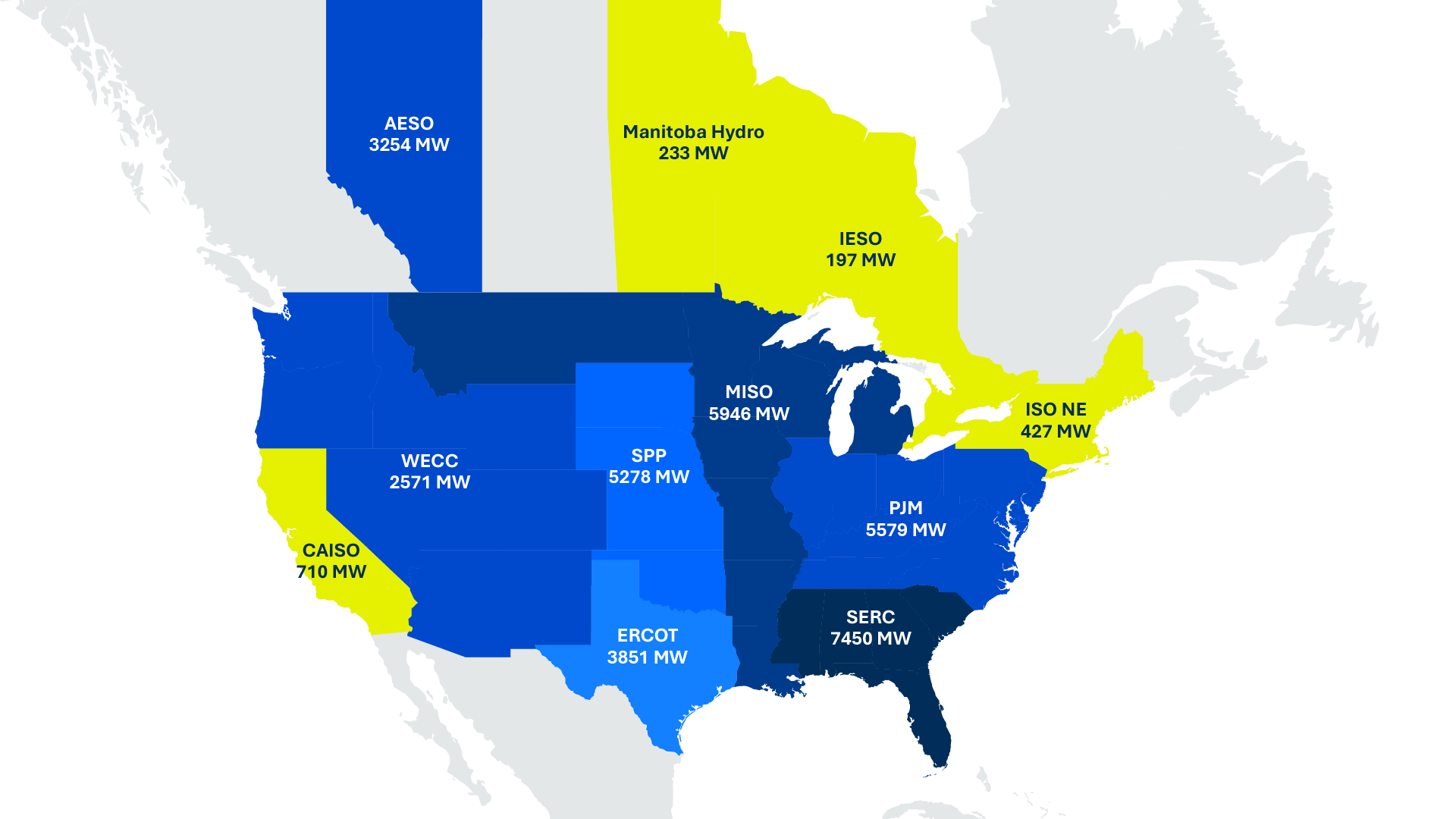
The case for a conversion is no longer based solely on heat-rate improvements. Adding output to an existing plant can provide more dependable capacity while making better use of an existing site and transmission interconnection (see Figure 1).

Figure 1: Potential for combined-cycle gas turbine conversions. Map was generated using 70 MW and post-2000 filters to identify potential candidates.

In a tight gas market, a conversion can offer an advantage over a new plant by avoiding or deferring some of the cost and delays associated with securing new firm gas transportation and building other infrastructure. That can be significant because securing new pipeline capacity often requires long-term commitments before a project is fully approved, creating both schedule and financial risk.

Those potential savings, however, need to be weighed against the costs of operating a more efficient plant. A combined-cycle unit is likely to run more often than a simple-cycle one, increasing annual fuel consumption even if peak fuel demand remains unchanged. Higher utilization can also increase variable operating and maintenance costs, and combined-cycle facilities typically require more staffing and maintenance than simple-cycle plants.

The value of the conversion therefore depends on whether the additional generation and infrastructure savings outweigh the higher capital and operating costs of running the plant more frequently. 

Evaluating Conversion Opportunities

Converting a simple-cycle gas turbine can reuse valuable equipment and leverage an established site, but those advantages do not by themselves make a project viable. Owners must assess the turbines’ remaining useful life, determine whether the site can accommodate the added steam cycle, and establish whether expanding gas operation, permits and transmission can support the converted plant.

A four-stage screening process can help owners test those constraints before comparing conversion costs with a new build option.

Stage 1: Screen existing plants.

Evaluate the plant’s age, turbine configuration, exhaust characteristics and remaining life, as well as key site, environmental and transmission constraints. The initial screen identifies sites where the steam cycle may be technically practical and offer an advantage over new construction. Later screens will examine each turbine’s condition and exhaust performance, and determine whether exhaust from multiple turbines could feed a shared steam cycle.

Stage 2: Assess gas deliverability and expansion options.

Estimate the gas volumes and delivery profile needed to operate a plant converted to CCGT at a higher capacity factor. Determine whether firm transport is available to support that operation and, if not, identify any needed pipeline upgrades. Compare the cost and schedule of securing gas delivery for the conversion against those associated with providing the gas infrastructure needed for new generation on the owner’s system. Apply the same assessments to each viable new-build option. For each option, estimate delivered fuel costs, identify delivery constraints and determine the earliest feasible commercial operation date (COD).

Stage 3: Model the economics of each option.

Evaluate each conversion and new-build option in an economic dispatch model using its output, heat rate, fuel costs, capital cost and COD. Compare modeled dispatch, fuel consumption, market revenues and total system costs across the options.

Stage 4: Advance viable conversions to due diligence and project development.

For any conversion that passes the initial screening, inspect the turbine with the original equipment manufacturer (OEM) to assess its condition and remaining useful life. Identify upgrades, repairs or replacements needed to support the planned operating profile and expected plant life. Develop a conceptual design for conversion, define the project scope and prepare project budget-grade estimate. Confirm gas delivery, interconnection and permitting requirements, and schedules.

Additional Considerations

Evaluations may show that upgrades to existing turbines or relocating gas turbines would deliver greater value. Each path places different demands on capital outlay, schedule, fuel delivery and transmission, so owners’ evaluations and decisions should reflect the value of the resource within their own systems.

What has changed is the value of a viable site and existing gas infrastructure. An existing plant with usable equipment, a gas delivery path and transmission access offers advantages that are increasingly compelling as demand growth is surging. Owners who identify those advantages early can take advantage of their existing fleet and sites to get more power while achieving faster in-service timelines.

A Practical Path Forward

New gas-fired plants are becoming harder to site, fuel and connect to the grid. That gives owners reason to take a fresh look at the simple-cycle assets already in their systems. A conversion will not fit every plant, but for the right asset it can change the planning conversation from “How do we secure more fuel and infrastructure?” to “Can we create more value from the infrastructure we already have?” For owners with simple-cycle assets in constrained or fast-growing markets, the practical next step is a focused screening study to determine whether conversion belongs in the resource plan.


Authors

Will Graham

Will Graham

Senior Mechanical Engineer

Barrett Kerschbaum

Barrett Kerschbaum

Senior Technical Advisory Consultant

Megan Parsons

Megan Parsons

Senior Consultant