White Paper

An Integrated Blueprint for Large-Scale Transmission Development

Standing up the substantial mileage of necessary extra-high-voltage transmission lines is a formidable task. A comprehensive approach is critical to streamline delivery and achieve cost-effective solutions to provide reliable service.


The United States is undergoing the largest transmission build‑out in generations. Surging demand, diversified generation and resiliency pressures are straining an aging grid. Utilities, developers and grid operators face unprecedented pressure to expand capacity quickly while maintaining reliability and protecting ratepayers. In this environment, successful delivery of extra-high-voltage (EHV) transmission takes a structured, end-to-end approach that aligns stakeholders for capital efficiency while reducing regulatory hurdles and project risk.

What follows is a multipillar blueprint for success.


Read More  

The United States is undergoing the largest transmission build‑out in generations. Surging demand, diversified generation and resiliency pressures are straining an aging grid. Utilities, developers and grid operators face unprecedented pressure to expand capacity quickly while maintaining reliability and protecting ratepayers. In this environment, successful delivery of extra-high-voltage (EHV) transmission takes a structured, end-to-end approach that aligns stakeholders for capital efficiency while reducing regulatory hurdles and project risk.

What follows is a multipillar blueprint for success. 

Pillar 1
Planning & Strategy: Aligning Capital With System Needs

While capital spending by investor-owned utilities (IOUs) has doubled over the past decade, customers’ ability to absorb rising electric bills remains limited. As IOUs plan for the future, they must weigh customer needs against independent system operator (ISO)/regional transmission organization (RTO) projects that advance broader regional grid goals. Reconciling competing demands calls for an upfront portfolio-based approach, one that evaluates timelines, weighs risks and considers long-term objectives. Success depends on early alignment between investment priorities and system needs, transparent communication, and analysis that broadens the view of system benefits.

An effective planning process begins with a forward-looking view of how the grid will evolve. Large load interconnection, electrification, distributed resources and renewables are reshaping where and when power is needed or available.

To better manage uncertainty and holistically evaluate system benefits, FERC Order 1920 and related planning studies promote transmission planning based on multiple long-term scenarios that reflect expected changes in load growth and generation mix over the next 20 years. When transmission backbone development is coordinated with future generation and load locations, projects are more likely to be rightsized and well positioned to meet evolving system needs.

In addition, permitting feasibility must be established early. Transmission corridors face significant scrutiny, and even technically sound routes can stall if community or environmental concerns are not addressed early. By collocating within existing rights-of-way where possible, developers can minimize land-use challenges. Early screening for audible noise and radio interference (AN/RI) and electromagnetic fields (EMF) provides valuable data to address community sensitivities. Likewise, flagging cultural and environmental factors early helps avoid costly rerouting.

Regulatory tools also help keep projects on track. The Department of Energy’s (DOE) updated National Environmental Policy Act (NEPA) categorical exclusions speed reviews for certain low-impact activities, while the FAST-41 timetable coordinates federal and state reviews under a single master calendar, reducing delays caused by fragmented processes. Together, these tools provide developers with clearer pathways through complex permitting requirements.

When combined with early identification of high-value routes and substation solutions, these practices do more than de-risk projects. They establish credibility with regulators, reduce total system cost, and create a more predictable path for cost allocation and scheduling across jurisdictions.

The Case for Coordinated Planning

Coordinated planning done early — setting demand and growth scenarios, addressing system and siting constraints, and locking in equipment needs — delivers proven, far-reaching benefits.

Coordinated Planning Benefits Transmission Lines Substations
Rightsizes assets
  • Aligns conductor size, tower geometry and capacity with long-term demand
  • Prevents delays, overpurchases and redesigns of high-cost, long-lead items
Avoids piecemeal fixes, redesign and overruns
  • Streamlines permitting across jurisdictions
  • Accounts for long-lead equipment, steel and other materials
  • Prevents costly redesigns of shunt devices, ROW
  • Reduces need for incremental upgrades after projects go into service
  • Locks in transformer, grounding and reactive support specs early
  • Reduces outage windows, change orders and budget risks
Mitigates risks
  • Improves cost-benefit ratio and lowers capital risk by addressing congestion and reliability constraints upfront
  • Keeps procurement on track and minimizes change orders by flagging technical challenges (surges, geomagnetic disturbances, fault current) early
  • Minimizes outages by phasing construction, using mobile transformers and selecting GIS/AIS early
  • Controls costs by locking in substation equipment choices and construction sequencing upfront
Streamlines permitting
  • Eases permitting by demonstrating proper sizing and reliability benefits, lowering soft costs, and aligning with revenue requirements
  • Reduces opposition and expedites environmental reviews by documenting compliance with noise, EMF and footprint requirements
Integrates reactive support  
  • Stabilizes voltage and manages long-line charging with proper siting/sizing of shunt reactors, SVCs and STATCOMs
  • Lowers lifetime system costs
Pillar 2
Early Electrical Studies: Building the Technical Baseline

At EHV levels — 345-kV, 500-kV and 765-kV — transmission lines and substations serve a broader purpose than simply connecting endpoints. Each project is designed to meet specific performance objectives, whether improving system reliability, enhancing grid resiliency or achieving economic targets. Maintaining focus on these performance outcomes throughout design and engineering is essential.

To carry these performance goals into design, planning-grade electrical studies — including steady-state, short-circuit and stability analyses — are often performed early in the process. They establish a technical baseline aligned with system planning practices and help keep design decisions consistent with overall system performance requirements.

The primary purpose of early electrical studies is to validate design specifications and identify any need for mitigation measures to reflect design basis. Advanced modeling and analyses using electromagnetic transients (EMT) programs are often used to assess transient switching and frequency-related risks, including energization overvoltage, switching overvoltage, lightning overvoltage, transient recovery voltage and resonance. In addition, geomagnetic disturbances (GMD) analysis may be performed when large grounded wye transformers are part of the system design and susceptible to geomagnetic events.

Together, these early analyses help lock in critical design parameters — such as right-of-way width, tower geometry, conductor bundle configuration, circuit breaker ratings, and surge arrester selection and placement. Confirming these specifications early in the process reduces permitting and procurement risks, supports alignment between engineering and construction, and helps maintain schedule reliability throughout project execution.

Key Early Overhead Transmission Studies

Early transmission studies provide cost and schedule certainty long before detailed design reaches 30%–60% design milestones. They also anchor later permitting and procurement decisions.

Study Area Focus Key Outcomes
Baseline studies (power flow and stability) Power transfer, voltage profiles, overload mitigation; angular stability, transient voltage performance Confirmation of the project target performance
Transposition and induced voltage Phase imbalance, zero sequence current, induced voltage Sets transposition tower location and phasing sequence, distance between phases, need for ground switch
Lightning and grounding Shielding, insulation, structure grounding Meets outage-rate targets; avoids late-stage tower, insulator and arrester retrofits
Corona, RI and audible noise Bundle size/spacing; conductor spacing and surface treatment Meets permitting needs for audible noise and radio interference; documents seasonal and wet-season performance for permitting
Collocation and AC interference Induction and fault current transfer in ROW shared with pipelines/railways Early AC mitigation (grounding mats, gradient control, bonds) prevents civil rework

Key Early Substation Studies

Early substation studies drive breaker ratings and counts, bus configuration, arrester and insulation levels, shunt device sizing, and energization procedures, thereby preventing serial redesign once major equipment is on order.

Study Area Focus Key Outcomes
Insulation coordination and transient switching Switching surge and temporary overvoltage (TOV); basic insulation levels (BIL); transient recovery voltage (TRV) Sets insulation strength and arrester ratings; prevents reignition and equipment overstress; validates breaker/arrester ratings
Reactive power and voltage control Bus/line shunt reactors, STATCOM/SVC sizing; long-line energization; confirms breaker duties Maintains voltage through contingencies and long-line energization; validates breaker and TRV ratings
Protection and reclosing philosophy Single-pole tripping and reclosing; line/station protection; comms schemes; auto-reclose timing Improves stability margins; coordinates station and line protection for resilience
GMD readiness (TPL-007-4) Geomagnetically induced currents (GIC) on large autotransformers; risk mitigation Protects transformer health; need for neutral current blocking device; enables compliance with NERC TPL-007-4 standards
Pillar 3
Routing, Education and Public Involvement: Securing Buy-In

No transmission project can move forward without a route that is both publicly acceptable and legally defensible. Routing is more than an engineering exercise — it is an iterative process that weighs constructability, environmental constraints, cultural resources and community input. Success depends on a multidisciplinary team that can reconcile competing priorities to identify a cost-effective route.

Cultivating trust and cooperation also requires transparency, helping the public and regulators understand the purpose, need and broader value of transmission system expansion. Open houses, hearings and other forums help demystify these projects, clarify constraints and build understanding of how routing decisions are made.

Because community input is integral to routing, engagement should include a public involvement plan that establishes clear communication channels with residents, leaders and agencies. Treating states and communities as co-designers rather than after-the-fact reviewers strengthens the foundation for development. Early commitments to community benefits — such as local hiring, compensation funds and/or broadband along rights-of-way — reduce opposition and add tangible value. By involving the public meaningfully in route selection, developers build credibility that supports right-of-way negotiations with landowners to secure construction access. Alternatives and key decisions are documented in a route study, the backbone for regulatory filings required for construction. A route study also sets the foundation for permitting by identifying potentially necessary permits, anticipating environmental impacts and preparing teams for construction requirements.

Case in Point: Greentown-Reynolds 765-kV Corridor
Indiana

The Greentown-Reynolds 765-kV project links central and northern Indiana. For this line, Burns & McDonnell evaluated more than 20 corridor permutations, overlaying wetlands, karst formations and cultural resources. The selected route minimized environmental crossings while keeping span lengths economical.

Learn more about the project

Pillar 4
Engineering: Designing for Reliability and Constructability

Once planning, studies and routing are in place, detailed engineering begins. The key to success at this stage is integration — treating EHV transmission lines and substations as interdependent assets rather than isolated projects, and engineering them in tandem.

By advancing routing, siting, public engagement, real estate, environmental and permitting design, procurement, and construction along parallel paths — and pairing them with clear accountability and rapid decision-making — an integrated approach compresses schedules while keeping designs aligned. A concurrent workflow adapts to the full spectrum of substation voltage classes and project design requirements, making it effective for maintenance, replacement projects, line rebuilds and greenfield development.

For EHV transmission, reliability is established by subjecting designs to rigorous testing. These tests validate spans, structures and clearances against national and utility standards. They also confirm that conductor performance, insulation strength and tower configurations can withstand the electrical and mechanical demands of EHV.

Reviewing every design package through a construction lens further helps anticipate real-world challenges. Because constructability is a key driver in tower design, teams often look for solutions that simplify erection. Ground-level preassembly of main sections, modular components that can adapt to variable or uneven terrain, and standardized connections all contribute to safer, faster and more cost-effective construction. Similarly, terrain hazard assessments flag geotechnical risks early, enabling accurate foundation pricing and reducing the likelihood of change orders during construction.

When embedded across the enterprise, constructability practices establish procedures that minimize design errors and omissions while treating downstream safety and maintainability as core design criteria. 

Case in Point: Smart Path Connect
New York

On the 55-mile Smart Path Connect upgrade of transmission lines in northern New York, Burns & McDonnell used a common PLS-CADD and building information modeling (BIM) environment that enabled structural, geotechnical and physical teams to resolve clashes in real time. The project energized six months ahead of schedule and now delivers 1.2 million megawatt-hours of renewable transfer capability each year.

Pillar 5
Construction: Executing Safely in Complex Environments

Construction is when planning and engineering are put to the test. For EHV transmission, IOUs measure outage windows in hours, not days, requiring tightly choreographed execution. Embedding safety and constructability reviews in design allows field teams to inherit a plan built around human performance — reducing physical risk, minimizing live-line exposure and standardizing lift procedures. A culture of learning that extends through commissioning — guided by supervisor feedback — creates an environment in which teams refine processes and improve performance in real time.

Successful project delivery also depends on tightly coordinated logistics and real-time data that drive responsive, confident decisions. In the field, that means synchronizing material deliveries, helicopter lifts and live-line work to maintain progress. Increasingly, digital field management tools make that coordination possible, with real-time data feeds from drones, lidar and geographic information system (GIS) platforms that help teams validate clearances, track component installation, and verify safety and quality compliance almost instantly. Integrating these systems with project controls reduces rework and strengthens accountability across the team.

An integrated delivery team — as opposed to the fragmented handoffs that can occur among contractors — streamlines delivery by reducing risk, shortening schedules, providing one point of contact and fostering design-construction innovation. 

Case in Point: Limestone Ridge Transmission and Substations
Missouri

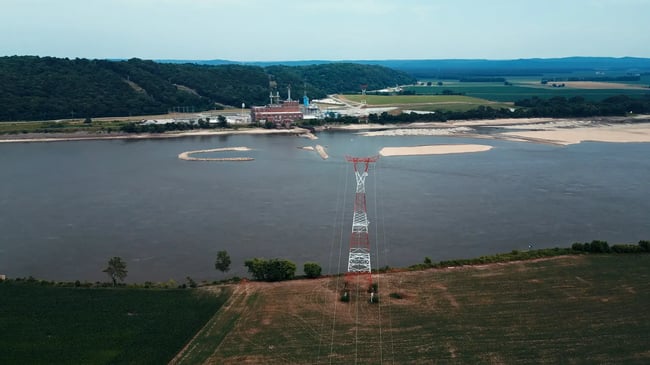
To boost power supply reliability for one of its utility co-ops in Missouri, Wabash Valley Power Alliance constructed several substations and transmission lines, one of which required a complex Mississippi River crossing. Close coordination among environmental monitors, barge operators and linemen enabled crews to install bundled conductors across the main channel within a single 48-hour window, protecting navigation and avian migration schedules.

Learn more about the project

Safety in Practice

With a total recordable incident rate (TRIR) of 0.16 over more than 32 million work-hours in 2024, the Burns & McDonnell safety record beats the industry average substantially. The firm’s “Safety by Design” methodology embeds safety into the engineering process, identifying and mitigating hazards early, and carrying those safeguards through construction, operation and maintenance. The result is safer project execution and sustained protection across an asset’s life cycle.

Pillar 6
Project Delivery: Choosing the Right Model

Project delivery is where vision becomes reality. The right delivery model transforms planning and technical precision into measurable outcomes: schedule certainty, cost predictability and regulatory confidence.

Major transmission and substation projects rival large construction programs in size and complexity. They span multiple years, involve many disciplines, and demand coordination across shifting priorities, regulators and stakeholders. To manage this scale, two delivery models dominate: program management (PM) and progressive engineer-procure-construct (EPC).

  • Program management: Under this model, the owner enters into direct contracts with constructors and suppliers while benefiting from portfolio-level management tools throughout the project life cycle. These tools — including earned value tracking, rolling risk registers and decision logs — support efficient capital deployment, proactive risk management and transparent decision-making when priorities or external conditions shift.
  • Progressive EPC: This model goes further by consolidating accountability under a single EPC contract, with the EPC partner assuming comprehensive responsibility from planning through energization. By running early engineering, procurement and construction planning in parallel, the progressive EPC approach compresses overall schedules, safeguards outage windows and maintains energization dates while preserving flexibility to optimize scope. The overlapping phased structure also enables the project team to establish preliminary cost and schedule targets during early engineering, refine them as designs mature, and make critical early commitments for materials with long lead times. This is particularly important in today’s market, as lead times for transformers, breakers and steel can jeopardize schedules if procurement is delayed.

Key Differences Between Program Management and Progressive EPC

Program Management Progressive EPC
Program management principles applied to entire life cycle of a megaproject A single EPC partner assumes end-to-end responsibility for the megaproject
Owner retains direct contracts with constructors and suppliers Entire project is completed under a single EPC contract
Model provides transparency, governance and efficient capital deployment Model compresses schedules, simplifies interfaces and provides IOUs higher delivery certainty


Case in Point: Illinois Rivers Transmission Project

Missouri, Illinois and Indiana

Ameren’s Illinois Rivers Transmission project, a 375-mile, 345-kV transmission line that was constructed from Palmyra, Missouri, to Sugar Creek, Indiana, aims to enhance energy reliability and transmission capacity in the Midwest. By using a helicopter for nearly all construction and foundation work on the project, the Burns & McDonnell program management team met an aggressive two-year schedule while minimizing environmental impact on sensitive wetlands and agricultural land.


Case in Point: Boone to Ward Hollow Transmission Line Rebuild

West Virginia

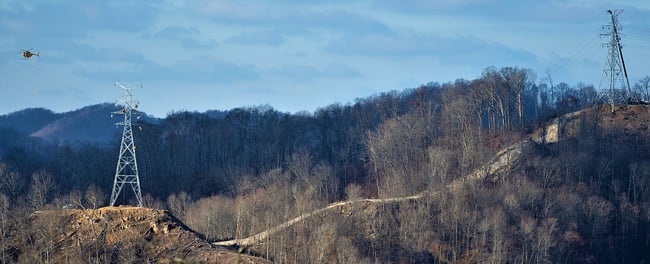
This AEP project involved the retirement and reconstruction of a 34.5-kV transmission line to 69-kV and 138-kV systems over 36 miles in Boone and Kanawha counties in West Virginia. For the 138-kV rebuild, the AEP and Burns & McDonnell EPC team sequenced construction around permit approvals and material deliveries to navigate mountainous terrain and pandemic-related disruptions, meeting all regulatory and outage-driven deadlines.

Learn more about the project

Pillar 7
Commissioning and Beyond: Closing the Loop

Commissioning is the final test of whether decisions made years earlier have been carried through to completion. At this stage, everything from reclosing sequences to energization must align with established study assumptions.

A fragmented project delivery chain often can lead to gaps in schedules and disputes over responsibility. In contrast, an integrated partnership removes handoffs that normally occur at three junctures: planning to engineering, engineering to construction, and construction to operations. When the same team carries forward tools like single-line diagrams and outage strategies from early system planning through final commissioning, the original design intent is preserved, avoiding costly rework. Regulators value this continuity because it prevents duplication and builds trust.


Case in Point: New York Energy Solution

New York

With the New York Energy Solution project, New York Transco upgraded 55 miles of 345-kV transmission in upstate New York to reduce congestion and increase the flow of clean energy to downstate population centers. During commissioning, the same specialists who had prepared the permitting application’s initial Article VII filing testified on construction practices in evidentiary hearings. Keeping the same subject-matter experts in place preserved project knowledge, created a consistent record and streamlined regulatory proceedings.

Learn more about the project

Looking Ahead

The next wave of EHV transmission is being driven by reliability mandates, decentralized generation integration, rising demand, new generation sources and the need for stronger regional ties. These imperatives arrive at a moment when material, equipment, labor and EPC resources are in limited supply, creating a narrow window for action.

Those who align capital strategies, permitting, design and construction early will be better positioned to deliver large-scale projects efficiently. Alternative delivery models such as integrated planning model (IPM) and progressive design-build provide the structure to carry EHV projects successfully from concept through commissioning. By acting with urgency, utilities can meet regulatory expectations, manage risk and reinforce grid resilience for decades to come.

EHV Transmission Expansion at a Glance 

Region Investment Scope Focus/Purpose
Midcontinent ISO (MISO) $21.8 billion 3,631 miles of 765-kV backbone plus nearly 5,000 miles of MISO-SPP interregional projects Midwest backbone expansion, regional and interregional projects
Southwest Power Pool (SPP) $7.7 billion 2,333 new miles plus 495 miles of rebuilds across 89 projects Resilience, winter storm vulnerabilities, load growth
Energy Reliability Council of Texas (ERCOT) $33 billion (about $5 billion/year for six years) Approximately 2,500 miles of 765-kV Strategic expansion, Permian Basin reliability
PJM Interconnection   Tie-ins with MISO and new east-west corridors Interregional flows, grid stability, transfer capacity

Authors

Dong-Hyeon Kim

Senior Managing Director
1898 & Co.

Amanda Olson

Vice President

Laurie Spears

Business Development Manager