White Paper

Adding Utility-Scale Carbon Capture to Combined-Cycle Power Plants Requires Whole New Mindset

Operational differences between combined-cycle power facilities and post-combustion carbon capture units demand contracting strategies built for the convergence of power generation and chemical processing.


Driven by a combination of market, policy and financial factors, utility companies and other generation asset owners are increasingly looking to post-combustion capture of carbon dioxide (CO2) to reduce emissions from their gas-fired fleets.

Combined-cycle power plants are emerging as the primary candidates for a strategic capital investment project like post-combustion carbon capture, due to their high capacity factors and long operational lives. While many capture technologies exist and the industry continues to evolve, most near-term project evaluations are selecting an amine-based system.

Heavy industries have relied upon the core process of amine-based carbon capture for decades to treat refinery gas, prepare natural gas for liquefaction, and purify feedstocks for hydrogen production. The process uses a regenerative liquid solvent to selectively remove CO2 from an industrial gas stream. Once heated, the solvent releases a relatively pure CO2 stream that only requires dehydration prior to compression for offtake or sequestration.


Read More  

Driven by a combination of market, policy and financial factors, utility companies and other generation asset owners are increasingly looking to post-combustion capture of carbon dioxide (CO2) to reduce emissions from their gas-fired fleets.

Combined-cycle power plants are emerging as the primary candidates for a strategic capital investment project like post-combustion carbon capture, due to their high capacity factors and long operational lives. While many capture technologies exist and the industry continues to evolve, most near-term project evaluations are selecting an amine-based system.

Heavy industries have relied upon the core process of amine-based carbon capture for decades to treat refinery gas, prepare natural gas for liquefaction, and purify feedstocks for hydrogen production. The process uses a regenerative liquid solvent to selectively remove CO2 from an industrial gas stream. Once heated, the solvent releases a relatively pure CO2 stream that only requires dehydration prior to compression for offtake or sequestration.

However, integrating an amine-based chemical process into a power generation facility is not a simple equipment upgrade. It is an entirely new commercial and project execution model that requires a fundamentally different mindset. The contracting differences between a combined-cycle project and a carbon capture project are the most pronounced in the following five areas:

  • Procurement of the core technology.
  • Cost estimating.
  • Structuring of performance guarantees.
  • Revenue streams.
  • Managing plant operations and maintenance.
Procurement of Core Technology

In traditional execution of a combined-cycle project, procurement is centered on physical assets. Major components of the plant, such as the gas turbine, steam turbine, and heat recovery steam generator (HRSG), are purchased directly from their respective original equipment manufacturers (OEMs), effectively bundling the core technology and the hardware into equipment-focused agreements.

A large amine carbon capture project, conversely, adopts a model that is common in the oil and gas industry. After selecting a technology supplier, the project will move forward by acquiring intellectual property through a licensing agreement. The technology supplier provides a proprietary process design package (PDP), which is essentially the chemical recipe for the carbon capture process. Once the PDP is in hand, an owner typically then turns to an engineer-procure-construct (EPC) firm to design and construct the physical facility, guided by the specifications included within the PDP.

This license-then-build approach is standard for refineries. However, for the power industry, this is a fundamental change to a typical project execution plan. It demands that the owner become a hands-on project integrator — moving from a focus on equipment procurement toward active management of the interface between process design and construction.
Cost Estimating

Cost estimating for a traditional combined-cycle project is a mature and streamlined process. Drawing on decades of historical data from similar plants, EPC contractors can develop budgetary cost estimates with high confidence after only limited upfront engineering. This data-driven approach provides a firm financial baseline, allowing an owner to confidently determine if the project’s economic model is viable and ultimately progress to the final investment decision (FID).

By contrast, when an owner tasks an EPC contractor with estimating a carbon capture project, the process begins with a blank slate. With no significant fleet of operational post-combustion carbon capture projects to provide historical benchmarks, the initial cost estimate carries a high degree of uncertainty. This uncertainty necessitates a phased, stage-gate approach to progressively build confidence in a project’s technical and commercial viability before an FID can be made.

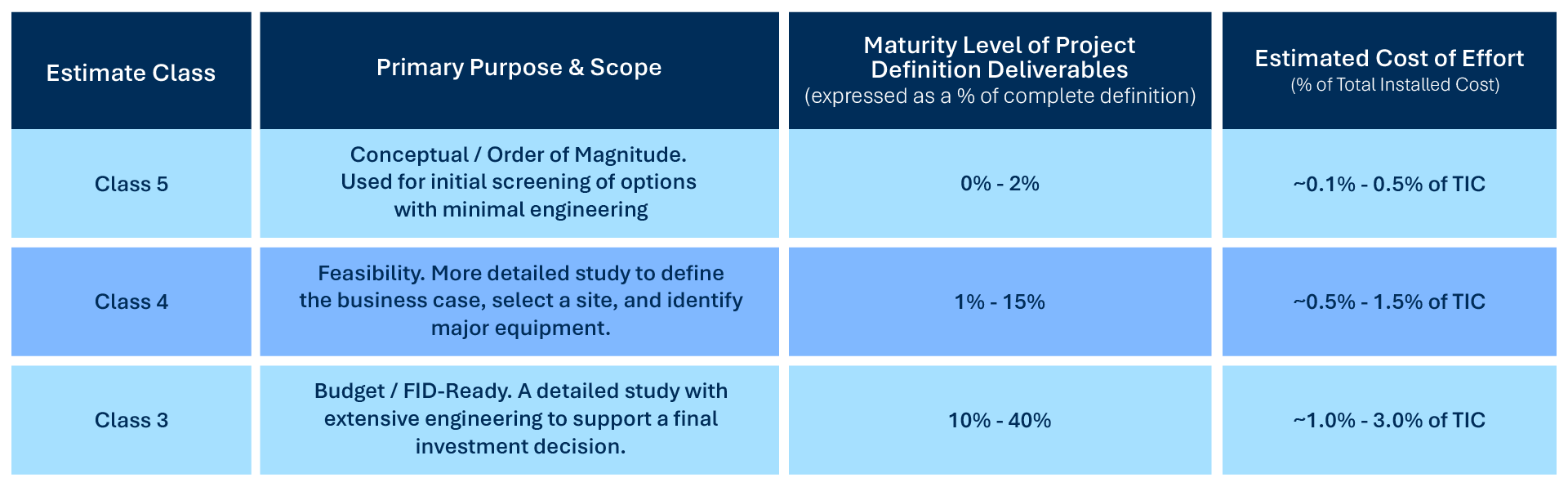
The industry-standard framework for a stage-gate approach to cost estimating is the AACE International (Association for the Advancement of Cost Engineering) 18R-97 cost estimate classification system. This structured process moves from a conceptual cost estimate (Class 5) to a budget-ready cost estimate (Class 3) suitable for an FID. The goal is to incrementally increase project definition, and therefore cost certainty, at each stage (see Figure 1).

Figure 1: The AACE classification system definitions reflect percentages of completion of engineering design.

CLICK TO ENLARGE

The primary advantage of adopting the AACE framework is that it allows the owner to make more strategic capital allocation decisions. It provides clear off-ramps for unviable projects while producing a well-defined scope and engineering deliverables for viable ones. The benefit is twofold: First, the detailed scope enables the EPC contractor to develop progressively higher confidence cost estimates; second, the cost estimates provide the owner with the data needed to make informed go/no-go decisions at each stage.

While the AACE stage-gate process is standard practice in industries like oil and gas, the power sector has often bypassed this rigorous upfront engineering for combined-cycle plants, thanks to decades of reliable cost data. With carbon capture, that advantage disappears. Owners must now adapt their project execution plan, using a series of early-stage engineering contracts to guide the cost estimate from a conceptual stage to an FID-ready budget.

Structuring of Performance Guarantees

The extensive operating history of combined-cycle plants gives OEMs the confidence to guarantee key performance metrics like output and efficiency. For years, owners bundled these under a single full-wrap guarantee from an EPC contractor, creating one point of responsibility. The current market trend, however, is a move away from this model. Though EPCs still routinely guarantee construction quality and schedule for items under their control, they are increasingly hesitant to assume full-wrap liability. This is leading owners to adopt a back-to-back structure with separate guarantees for the OEM equipment and the EPC's construction work.

On the surface, the performance guarantee structure for a carbon capture project appears similar to a back-to-back model for combined-cycle plants: The technology supplier provides process guarantees, such as CO2 capture rate and solvent consumption, while the EPC guarantees construction quality. However, the distinction lies in the financial risk. The technology supplier’s liability is typically capped at a percentage of its contract, but since a PDP is an engineering-only service, its value is a fraction of a power island OEM’s equipment contract. This leaves the owner with vastly lower financial protection. While an EPC could theoretically cover this guarantee gap, the lack of significant long-term operating experience for a post-combustion carbon capture application means the contingency and risk premium the EPC would need to charge would be so large that it would render the project economically unviable. This forces the owner to look beyond financial penalties and seek other means of risk mitigation.

The primary tool for this new mitigation strategy is the extensive engineering effort required to develop a Class 3 estimate. The purpose of this phase is not just to validate design and increase cost certainty, but to actively study the project's risks. During this process, a formal risk register is developed, forcing a disciplined conversation about potential failures. For each identified risk, owners must then determine their appetite for it, choosing one of three strategic paths:

  • Mitigate it with more design margin.
  • Redesign a system to eliminate it.
  • Formally accept it based on a cost-benefit analysis.
Revenue Streams

The revenue model for a combined-cycle plant is relatively straightforward. These power plants may operate as utility-owned assets, as independent power plants operating under a long-term power purchase agreement (PPA) with a utility or large industrial user, or as merchant plants that bid into wholesale power markets to supply power to the grid. Though each type of operating model carries varying levels of risk, the objective is similar — to earn revenue by selling electrons. For the most part, this results in a stable, predictable revenue stream that is key to gaining the financing needed to construct new plants.

The revenue model for a carbon capture facility is quite different. It is not based solely on the sale of a single commodity, but more likely on a complex stack of federal and state financial incentives, each with stringent obligations for compliance. The foundation of this incentive structure is the Section 45Q of the U.S. federal tax code, which provides tax credits for CO2 that is permanently sequestered or utilized for purposes like enhanced oil recovery (EOR). This federal layer may then be supplemented by state programs. For instance, states like Texas and Louisiana offer direct tax credits, while California’s Low Carbon Fuel Standard (LCFS) creates a market-based mechanism where captured carbon generates valuable new credits to be sold.

This new model means the utility is no longer just selling power; it is effectively manufacturing compliance. For financial purposes, the primary product is not the captured CO2 itself, but the monetizable tax credit it represents. This places the administrative functions of monitoring, verification and reporting at the center of the revenue-generation process.

Managing Plant Operations and Maintenance

For a combined-cycle plant, operations and maintenance (O&M) is centered around preserving machine health and availability through scheduled overhauls, capital parts replacements, and performance monitoring. This is typically managed under comprehensive long-term service agreements (LTSAs) with the equipment OEM.

O&M for the core process of a carbon capture plant, however, is managed through a suite of separate, specialized agreements focused on the process health. This includes a technical service agreement with the licensor for such items as process monitoring, solvent supply and management contracts with a chemical vendor, along with waste disposal agreements. Each contract addresses a distinct part of the chemical process operation, from solvent chemistry to byproduct management.

The day-to-day O&M focus is no longer simply on keeping the machines running, but on maintaining the delicate chemical balance required for profitable operation. This requires a new mindset for operational monitoring and risk management, centered on the chemistry of the process rather than just mechanical performance of the machinery. The service agreements for each vendor must then be carefully structured so that their individual scopes interlock to form a single, comprehensive O&M plan for total operational performance.

A New Playbook

The addition of carbon capture is more than just the next step in power plant evolution. It is a test of a utility's ability to adapt.

For leaders in the power industry, this introduces a new strategic reality. Moving forward will require more than just new technology; it will require a new organizational mindset borrowed from the oil, gas and chemical sectors. The critical question for every utility is, therefore, not if it will have to confront this new model, but how prepared the organization is to master it.


Authors

Allan Bartlett, PE

Senior Electrical Engineer

Tisha Scroggin-Wicker, PE

New Energy Solutions Director