White Paper

A New (Virtual) Reality for 3D Technology in the Utility Industry

Will traditional 2D computer-aided design processes someday feel as archaic as T squares and compasses? It might happen sooner than you think, thanks to swift advances in 3D technology. A peek at a future workflow that more holistically incorporates this technology hints at its potential.


Introduction

Many industries have already seen the revolutionary power of 3D design, visualization and printing. In healthcare, scientists use 3D printing tools to create bionic ears that hear beyond normal human capabilities, skin for burn victims, and patient-specific implants that more effectively cure bone cancer.

Ship designers are using virtual reality to explore the digital decks of warships, uncovering engineering issues while the designs are still on the drawing board. Architects develop stunningly realistic walkthroughs of yet-to-be-built structures that offer visceral perspectives of dimension and scale. NASA is using mixed reality software to let scientists and engineers virtually and collaboratively explore Mars. Engineers have put 3D models to use in planning new and retrofit projects for generation and oil and gas facilities.

The manufacturing industry is pairing 3D printing with robotics and artificial intelligence to speed the design, testing and prototyping process. MIT researchers created 3D printed graphene that is 10 times stronger than steel but a fraction of the weight. Aerospace companies are gaining efficiency and performance with 3D printed engine components. Even the final frontier — space — is relying on the technology, with several companies using 3D printed rocket engine components and a 3D printer on the International Space Station.

How can the utility industry prepare for the inevitability of this technology evolution — and even hurry it along?


Read More  

Integrating 3D Tools into Everyday Processes
  1. Gaining Awareness — A first step is gaining awareness of the capabilities and application of 3D technology on transmission and distribution projects.
  2. Integration of Technologies — Another step is remembering that innovating in three dimensions doesn’t rely on a single technology, but on the integration of multiple 3D technologies to completely transform workflows and processes. Individually, 3D visualization, scanning, design and printing are incredibly powerful tools. Together, they can be industry-changing.
  3. Active Testing — A third step is actively testing these solutions and working with consultants and vendors who strive to develop tools and processes that directly support utility efforts. After all, 3D tools have incredible potential to help projects achieve higher technical quality and gain greater efficiency, conserving budgets, speeding schedules and making project sites safer.

A Holistic 3D Workflow

A 3D laser scan quickly and easily captures millions of individual data points.

Each design discipline utilizes the same 3D model, encouraging seamless collaboration.

The 3D model automatically checks design requirements such as electrical clearances.

The design team 3D prints a portion of the design as a model to aid stakeholder understanding.

A design detail is adjusted; the change is automatically reflected on every drawing.

The design model is pivoted into a virtual reality (VR) flythrough for a community engagement meeting.

The software used to create the 3D design model autogenerates a bill of materials.

After a design change, the bill of materials automatically updates.

During construction, as-built laser scans are compared with the 3D model to measure progress.

The project is delivered; a final 3D scan results in precise as-built documentation.

The robust data from the 3D model is automatically transferred into an asset management system.

Field personnel notice a clearance issue during a virtual reality training session, make an adjustment and complete the repair safely.

The extensive 3D site data provides an ideal foundation for an expansion two years later.

Measuring Reality with 3D Scanning

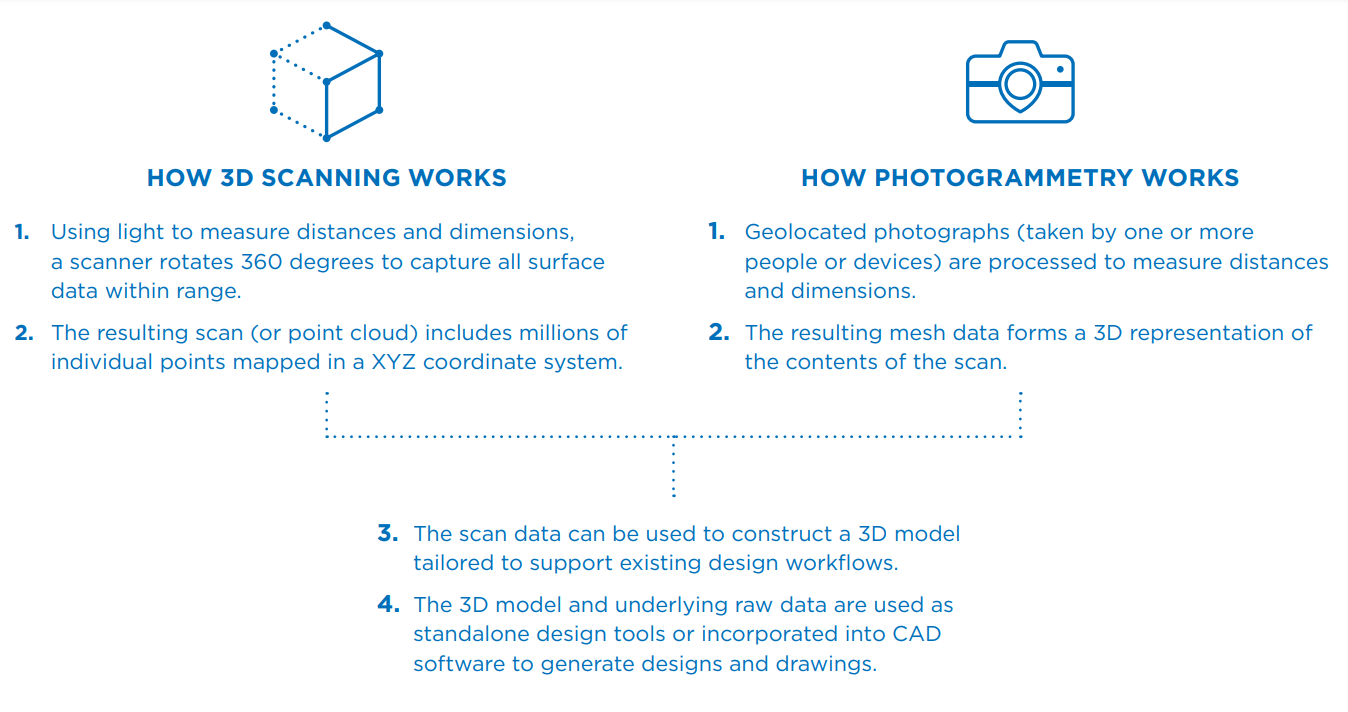
Good data lays a solid foundation for successful projects. Whether the site is brownfield or greenfield, accurate documentation is vital. Laser distance finders are now more common than tape measures, but that’s merely an incremental improvement. 3D scanning — including lidar (light detection and ranging) and photogrammetry — is a giant leap forward.

With the latest 3D scanners, lidar technology is used to measure distances and dimensions. The resulting point cloud includes millions of X, Y, Z or globally positioned data points, accurate to within a millimeter. Documentation can be even easier with photogrammetry. All that’s required is a camera, and the image processing-based technology often generates a less data-intensive mesh scan that can be beneficial if the large size of point clouds is undesirable. Regardless of the scanning method, the data that’s collected is a gold mine of potential information, serving as the backbone for a more efficient design process.

Laser scanning has been used for some time in relation to transmission lines. Scanners mounted on aircraft wings not only scan lines and structures, but also monitor for right-of-way encroachment or vegetation management issues. Of course, even this staple of lidar use is no stranger to current innovations, with drone-based systems making strides and an electric utility being granted the first beyond visual line of site certificate of waiver from the FAA. Moving beyond transmission corridors and aerial lidar, 3D scanning is increasingly deployed on the ground, and a surprisingly wide range of utility efforts can benefit, including:

  • Substation or other projects requiring critical dimensions and connections for existing structures, equipment and utilities.
  • Brownfield sites where information about an existing structure is out of date or absent.
  • Greenfield sites with an undefined space envelope and unknown surface conditions.
  • Environments where manual measurement is impractical or unsafe, such as substation areas inaccessible due to concerns like outage restrictions, or for project sites near busy highways, swamps, etc.
  • Projects where the scope is in flux, with a 3D scan minimizing the necessity of further site visits to capture additional site information.

When first considering 3D technologies, utilities will need to invest in equipment and trainers, but some engineering companies offer an alternative by including basic scanning as a service, often within existing projects. Using this approach, scanning becomes more accessible and the potential benefits can be directly evaluated as a part of ongoing design efforts. Depending on capabilities, utilities may also find that this approach allows for evaluation of multiple technologies and can be paired with evaluation of 3D design tools.

Considering the notable benefits — more accurate as-built information gathered in fewer site visits, leading to reduced rework, shorter design cycles and a safer work environment today and in the future — it’s no surprise the use of 3D scanning is dramatically increasing on utility projects.

CLICK TO ENLARGE

3D Design for a 3D World

Data is only as valuable as the work product it informs. Simply put, someone on the receiving end of the data collection process must know how to maximize the information so the project benefits. Usually, this happens during the design process with computer-aided design (CAD) software.

Most CAD vendors have added 3D capabilities to their suite of products. But because the transition from 2D to 3D can feel like a big leap, some transmission and distribution projects are still built using 2D plans. Yet each step, big or small, toward a 3D future will add value. Many consulting engineers have experience in transitioning clients between 2D and 3D design. Some companies are even helping support CAD vendors in the ongoing development of specialty tools for the utility industry.

Pushing forward is worth it, as integrating 3D technology during the design process helps projects reach the next level of safety, efficiency, quality and cost-effectiveness. Different disciplines develop plans in concert instead of isolation, so conflicts are identified and resolved earlier. Three-dimensional design tools can automatically generate and even update a bill of materials.

With 3D modeling, automation tools can support the design process. For instance, the software can send an alert about possible electrical clearance concerns or other issues. These advanced tools enhance the efforts of engineers and designers by adding another layer of risk management to the workflow.

 Three-dimensional models also come equipped with built-in intelligence that delivers even after the project is completed. Data from Building Information Modeling (BIM) — an intelligent, 3D model-based process that delivers insight and tools to more efficiently plan, design, construct and manage buildings and infrastructure — has been used for decades in various other industries. BIM data can become the basis for an asset maintenance and management system. For operators, that level of information means more informed and strategic decisions on how to run and maintain the system. The design team can even create an augmented or virtual reality model for training purposes, for use on VR headsets or field‑ready augmented reality systems. Imagine if maintenance personnel could safely practice a complicated repair in virtual or augmented reality before attempting it in real life. 
3D Printing with Precision

It might once have seemed a distant reality, but 3D printing is already here. Additive manufacturing (AM) — in which successive layers of materials are used to create a 3D object — is revolutionizing many aspects of manufacturing. While eye-catching videos of 3D printed buildings and prosthetics grab the headlines, AM is really making its mark in areas that include advanced turbine blades and aircraft engines.

The prime areas of opportunity on utility projects are in the supply chain, with 3D printed prototypes for custom parts already a common occurrence. As use of 3D design tools grows, 3D printing and fabrication technologies will become more capable.

For example, a plant modification project team working in three dimensions can scan the space, develop a design model based on the scan data and send exact 3D specifications to a pipe fabricator. The required piping is fabricated in the shop to the millimeter — a perfect fit. There’s no need for the fabricator to come on-site to measure, fabricate, check, measure and make field adjustments. Eventually, 3D fabrication technologies like these seem likely to become commonplace.

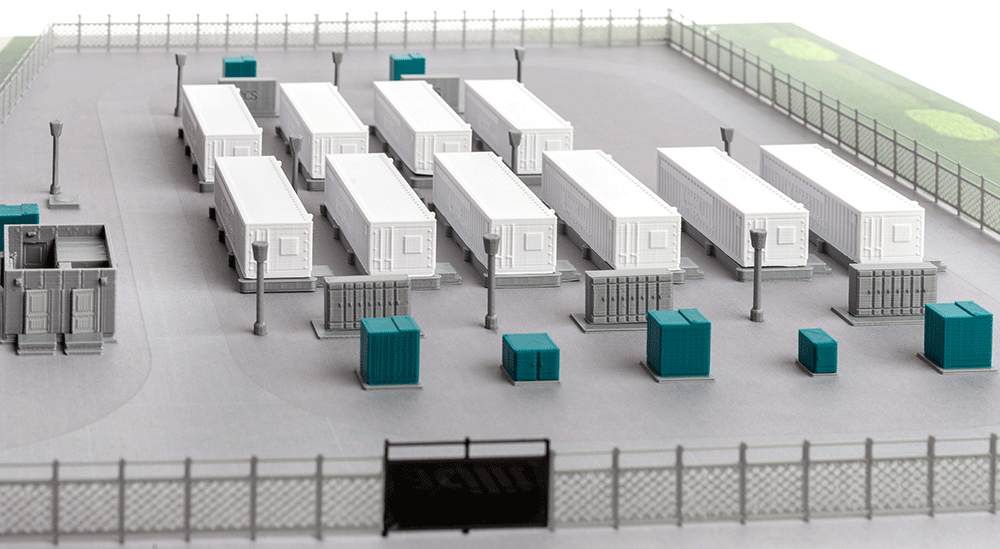
If this makes it sound 3D printing might not fit with your projects, look for opportunities to use it on a smaller scale, such as in producing training aids, or for design models that enhance client understanding or build community engagement. Especially on large capital projects, a simple model can make all the difference in communicating project goals.

Some engineering and architecture firms are developing their own visualization labs, complete with sophisticated 3D printers and laser cutters, to fill this need and enhance project communications for all stakeholders.

CLICK TO ENLARGE

An Approach with Dimensional Appeal

The workflow of a typical utility project might include a single 3D element or none at all. Yet 3D tools and technologies can make an impact during every phase: planning, design, construction, maintenance and operations.

In this data-driven world, there’s no question that 3D — a technology that’s built on data — is an inevitable innovation. Its power is already transforming industries, from manufacturing and industrial to retail and aviation. Will the utility industry embrace the 3D revolution and catch up with the change?


Author

Alan Washburn

Alan Washburn

Associate Technical Consultant