Nuclear energy today is attracting enthusiasm that is perhaps unprecedented since the Atomic era began. Nearly every government in the developed world has committed funding and other means of support to expand nuclear energy for a host of use cases.
Speaking at the March 2026 Nuclear Energy Summit in France, European Commission President Ursula von der Leyen acknowledged that Europe had made a strategic mistake in turning away from nuclear power over the past few decades. She then announced that Europe was adopting a new strategy of developing small modular reactors (SMRs) with a goal of producing significant power from these sources by the early 2030s.
In the U.S., a full-court press is underway to direct more than $100 billion to a full slate of nuclear initiatives. The Trump administration has issued a series of directives calling for nuclear power to be quadrupled to more than 400 gigawatts of electrical capacity (GWe) by 2050.
Under one part of that initiative, the U.S. Department of Energy (DOE) just announced the Utility Power Reactor Incremental Scaling Effort (UPRISE) as a fast-track approach to extend operating lives, uprate generating capacity and reopen mothballed nuclear facilities. The goal is to add 5 GWe by 2029 to the 97 GWe of power currently generated by the 94 plants comprising America’s nuclear fleet.
“Nuclear power really is at an inflection point,” says Luke Krooswyk, section manager within the Nuclear Group at Burns & McDonnell. “The projected load growth we’re seeing for the next few years will absolutely require more baseload capacity. Nuclear has to be part of the clean energy solution.”
Moving nuclear power forward will require staggering capital investments. Whether the projects are for life extensions or uprates of existing plants, addition of new plants to the operating fleet, or advanced new reactor designs, billions of dollars are in play.
For example, the price tag for the Westinghouse AP1000 light water reactor is estimated to range up to $10 billion per unit. The significant demand for new power generation facilities of all types, combined with the substantial data center and overall heavy industrial market activity, is creating high demand and leading to long lead times and limited supplies of critical materials and components — forces that are driving up costs for all forms of baseload generation.
Next-generation SMR nuclear facilities still require significant capital investment, but due to smaller scale the overall project costs may be more palatable. Subsequent deployments of the same technologies are expected to improve cost and drive schedule efficiencies. For example, the 300-megawatt (MW) BWRX-300 units now starting construction at Ontario Power Generation’s Darlington site are projected to cost $4.4 billion (USD) for the first unit. However, total project cost for four units is anticipated to be $15.1 billion (USD), per publicly available data.
“It’s pretty difficult to find investor-owned utilities or independent power producers with an appetite for this kind of capital risk,” Krooswyk says. “We’re not in the same regulated environment we were in 50 to 60 years ago, so when you don’t make a dollar on your investment for half a decade or longer, it limits the pool of private investors. That’s why we’re seeing the emergence of a rather unique public-private partnership model. We really need government backing for the proper market signals that will get the industry moving in the way it needs to be.”
According to many industry analysts, an increased role for government backing in projects, nuclear fuel development and critical equipment supply chains is vital if nuclear power is to quickly increase its share within the generation mix.
For example, the DOE recently entered a partnership with Westinghouse that could turn into an ownership stake as a means to accelerate deployment of the AP1000 light-water reactor. Additional backing for both conventional and next-generation nuclear technologies is coming from the 2025 U.S.-Japan framework agreement, a strategic $550 billion partnership that aims to strengthen a broad array of energy-related infrastructure initiatives.
“As government funding hopefully really takes hold, it will be interesting to see how it affects the market,” says Justin Schnegelberger, nuclear development manager at Burns & McDonnell. “The magnitude and extent of government funding and financial backing of nuclear technology development is likely to play a significant role in project implementation, speed to market and overall industry expansion.
“There are dozens of reactor technologies now under development, and many have received some substantial public- or private-sector investment. Ultimately, we’ll see the winners emerge but likely we’ll see some industry consolidation before that.”
Availability of advanced high-assay, low-enriched uranium (HALEU) fuel is perhaps the key to unlocking the puzzle over how quickly advanced nuclear technology can deploy.
Nuclear fuel feedstock is produced through a complex enrichment process that increases the concentration of the fissile uranium-235 (U-235) isotope. For conventional nuclear reactors using low-enriched uranium (LEU), the fuel must be enriched to a level ranging between 3% and 5% U-235. For advanced SMRs using HALEU, the U-235 isotope enrichment ranges between 5% and 20%.
However, the widespread availability of HALEU for advanced nuclear fuel is projected to be many years away.
“We’re looking at a bit of a chicken-or-the-egg situation with nuclear fuel,” says Gabriel Chavez, project manager and nuclear strategy leader at Burns & McDonnell. “HALEU is needed to optimize advanced reactors, but the fuel suppliers are reluctant to take on the costs and risks when even the reactor designs that are furthest along are still years away from commercial operation.”
Another major roadblock is a lack of domestic suppliers capable of providing any type of nuclear fuel feedstocks at the scale large enough to significantly expand the nuclear fleet. Currently, most of the available enriched U-235 fuel is from Russia, and a full U.S.-imposed ban on uranium imported from Russia takes effect in 2028.
“There has to be a role for government in addressing supply chain vulnerabilities for fuel,” Krooswyk says. “The domestic enrichment companies need assurance that someone is going to buy the fuel feedstock once it’s available.”
Because of the expected time lag before HALEU is widely available for commercial reactors, some projects are incorporating initial designs that utilize conventional light water LEU fuel in the interim. According to Chavez, major OEMs like Westinghouse and GE will likely soak up demand for LEU fuel for at least another 30 years, meaning that government support will be necessary to offset risks of developing the higher-density fuel needed for SMRs to operate most efficiently.
The nuclear reactor market offers dozens of technology options to potential purchasers. These technologies are being developed and tested by a mixture of industry newcomers as well as long-tenured suppliers.
Typically, the newcomers advertise innovative technologies, while mature suppliers lean on proven technology with incremental innovations. The likelihood of success lies somewhere in the middle of this spectrum. Although a culture of innovation is likely to result in creative engineering, effective project execution is needed to chart the most efficient course through a megaproject.
The value of experience cannot be understated. While the initial theoretical reactor design is generally the simplest part of the project, many issues will go unrecognized until components are being fabricated and construction is underway. The sooner a design moves from paper to prototype — and then from prototype to construction — the greater the likelihood of overall project success.
While there is increasing excitement within the industry due to the new entrants, a deeper look at the actual progress being made by players that are making strides in prototyping, testing and building the next generation of reactors is the basis for real optimism. That is because this is where the hard lessons are being learned, and these lessons will be the keys to long-term progress.
Though much of the industry’s attention is directed toward adding capacity to the grid, developments in the microreactor space also are fueling optimism. Microreactors are designed to provide on-site generation options in locations where the grid cannot support demands. With lower thermal power output than SMRs, microreactors are small and flexible enough to be transported by truck to serve use cases ranging from district energy facilities to remote mining operations or critical military missions.
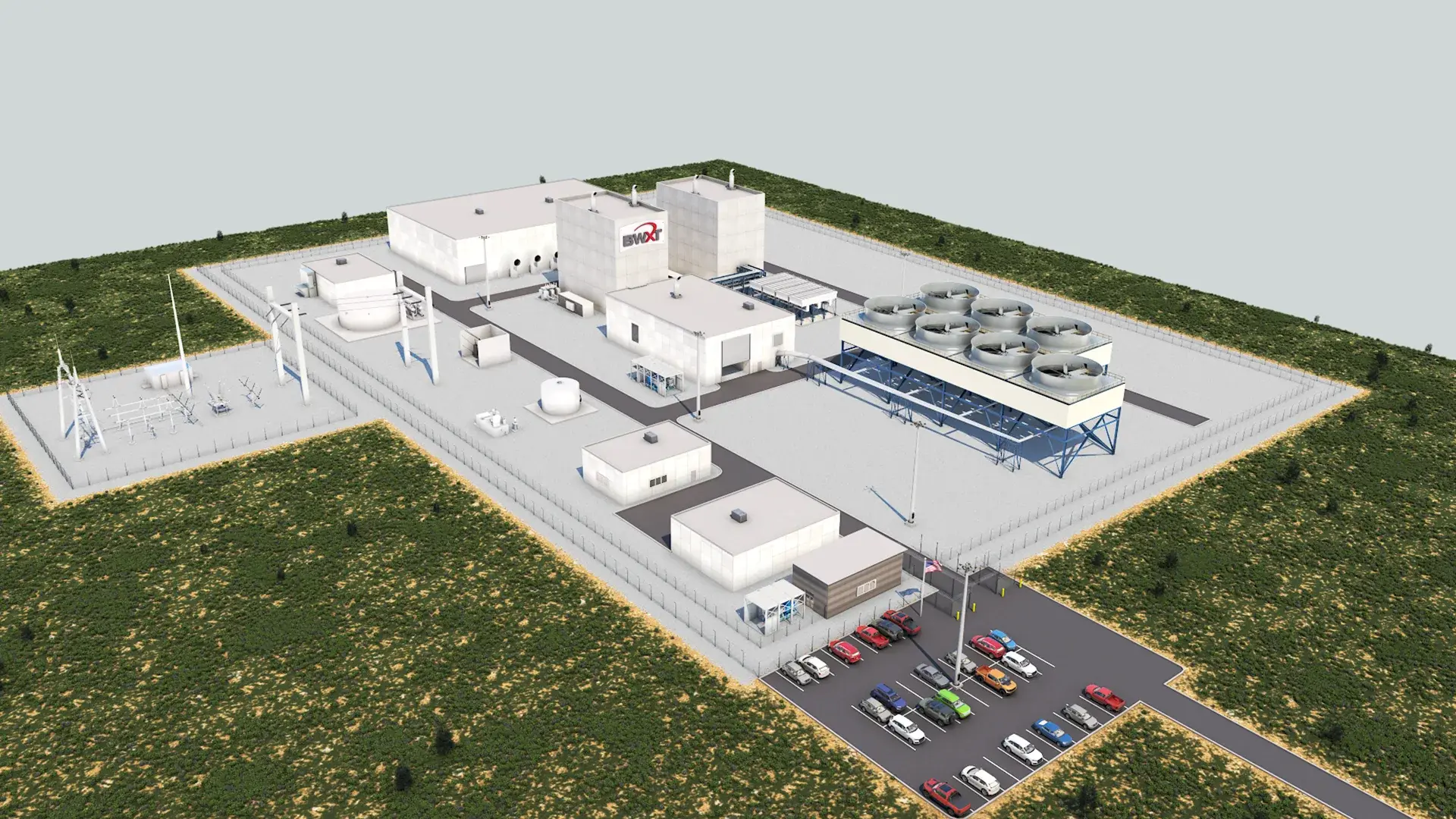
BWX Technologies Inc. (BWXT) and Burns & McDonnell have been collaborating to advance the design and development of one such microreactor, the BWXT Advanced Nuclear Reactor (BANR). Utilizing a standardized nuclear power system, BANR features flexible balance-of-plant configurations to provide cogeneration (heat and power) or electrical power solely to a variety of users in certain regions of the country.



.svg)


.svg)


.svg)




.png)