Cleveland Water Alliance works with a consortium of private and public sector partners who monitor wave height, E. coli levels, temperature and turbidity in Lake Erie. Bryan Stubbs, executive director of Cleveland Water Alliance, says the data serves to inform from a reactionary standpoint but will hopefully lead to more proactive and mitigating action in the future.
One biennial event attempts to ease the burden of finding solutions for maintaining water quality. Erie Hack, a program created and managed by the Alliance, which leverages partners throughout the basin, results in ideas to resolve issues swirling around drinking water and monitoring technologies that keep the resource safe. Bringing together consumers and water sector professionals, this competition calls for participating teams to research and present water solutions, as well as provides more than $100,000 in technology acceleration awards.
“Cleveland Water Alliance approaches economic development through the lens of water,” Stubbs says. “By bringing together different leaders in the industry, we are able to share innovation, technologies and the workforce to fully utilize resources.”
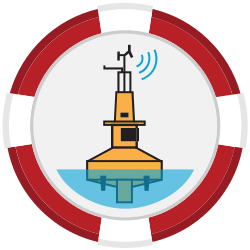
A testament to the progress made through Erie Hack, small, golf-ball sized smart buoys in development — equipped with sensors and webcams — will transmit real-time water quality data reporting turbidity, wave height and bacteria levels, among other items. The current, larger smart buoys face the challenge of frozen waters forcing the buoys to be pulled for the winter. The smaller buoys will be able to stay in year‑round, regardless of weather.
According to Cleveland Water Alliance, Lake Erie supports a $15.1 billion tourism industry, meaning water issues must be closely monitored to avoid a negative financial impact in the region.
“The Great Lakes region provides an incredible opportunity to solve the issues associated with maintaining clean water,” Sokol says. “The Lake Erie area boasts a huge shipping, fishing and tourism industry. Work in the water sector brings together municipalities and communities to form a lake propelled by innovative technologies.”
According to an estimate made by the Great Lakes Commission based on expected projects, nearly $10 billion will be needed in the next two decades to maintain water, stormwater and wastewater infrastructure in the Great Lakes area. Unfortunately, Sokol says, water infrastructure in the smaller communities making up much of the region often lacks the regular maintenance of larger communities.
Even with such complex issues surrounding the water industry, the future for continued clean water looks promising. Pairing regional and global experiences with the latest smart technology can improve communities in the Great Lakes region and beyond by catching issues earlier. Smart technology, along with larger, longer‑term water infrastructure projects, can help design and maintain more efficient water systems.



.svg)


.svg)


.svg)



.png)