Feature | October 26, 2026

Connecting in KC: Transit Planning and Communication Score World Cup Success

Navigating diverse languages, cultures and expectations meant developing a system nimble enough to accommodate spiking demand and unexpected occurrences.

Listening to KC2026 CEO Pam Kramer outline the challenges, opportunities and ambitions of Kansas City becoming a successful host city for the world’s largest sporting event, Meghan Jansen found herself looking ahead.

Her wheels were already turning.

“I remember thinking, ‘This is as much or going to be a people-communications puzzle to solve as it’s going to be a traffic and transportation-planning puzzle to solve, and this CEO gets it,’ ” Jansen recalls thinking while walking out of the crowded civic meeting at Union Station. “We can deliver this.”

Riding KC Streetcar, Meghan Jansen, project manager, discusses how user experience guided transportation planning during the 2026 FIFA World Cup in Kansas City.

Weeks after Kramer’s 2024 presentation, Jansen and her team at Burns & McDonnell were hired to provide planning and travel demand management for KC2026, the nonprofit tasked with hosting FIFA World Cup 2026 games in Kansas City, the smallest of the 11 U.S. host cities by population and annual international tourism. As such, organizers knew they would be entering the tournament as a clear underdog, with limited public transit infrastructure in the sprawling, car-centric Midwestern metro contrasting sharply with existing subway and commuter rail systems in coastal hubs like Boston and New York.

Yet by the final whistle, visiting federations, tournament organizers and international media recognized Kansas City as a standout success, with the region emerging as one of the tournament’s defining stops. The metro area served as a base camp capital, becoming one of only two host cities to secure four national teams: defending champion Argentina, plus England, the Netherlands and Algeria. Kansas City (Arrowhead) Stadium averaged 68,862 fans across six matches, while more than 400,000 visitors gathered at the FIFA Fan Festival, according to data released by KC2026.

The results were built upon strategy that had been meticulously planned and executed. And at the heart of this success was the temporary, secondary transit system built from scratch, which Burns & McDonnell helped bring to life.

“Years of planning and collaboration made this moment possible, and the leadership and expertise from Burns & McDonnell was critical — not just for travel demand management, but in the overall communication,” Kramer says. “Together, we proved Kansas City could provide a world-class transit experience that was exceptional, welcoming and effective.”

‘It’s Magical, Not Magic’

The challenge was immense. With the stadium miles from downtown and lacking passenger rail access, the city could not rely on existing lines. In partnership with the KC2026 Host City Committee, Jansen led the Burns & McDonnell team that helped develop the regional transit strategy and oversaw operational communications for ConnectKC26, the official transit network for the tournament in the region.

World Cup Connections

Transportation served as a cornerstone of the FIFA World Cup experience in Kansas City.

Even before knockout rounds began, the region’s first-of-its-kind system had provided more than 140,000 passenger trips through Stadium Direct, Region Direct and Airport Direct service to matches, celebrations and destinations throughout the metro. Breakdown of ridership:

31% local and regional | 56% national | 13% international

This map shows transit connections to destinations for FIFA World Cup in Kansas City, including Kansas City International Airport to the north, FIFA Fan Festival at center, and Kansas City (Arrowhead) Stadium to the southeast.

“By putting ourselves in the passengers’ shoes, we created transportation and communications processes to deliver a frictionless, positive journey for tournament transit users,” says Jansen, a project manager in the firm’s Transportation Group.

The team’s work on ConnectKC26 linked Kansas City International Airport, stadium gates, the FIFA Fan Festival and suburban park-and-ride hubs with a fleet of nearly 250 motorcoaches, many of them secured via first-to-market leases given intense competition across North America. Fans registered for more than 215,000 ConnectKC26 passes — including nearly 145,000 on Stadium Direct, more than 45,000 on Regional Direct and more than 25,000 on complimentary Airport Direct shuttles. The KC Streetcar logged its busiest days on record, while Kansas City earned praise for keeping transit affordable with $15 round-trip stadium passes.

World Cup Stats

Delivering that level of performance required both disciplined foresight and agile execution, says Julie Lorenz, senior adviser to KC2026 and senior managing consultant for 1898 & Co., part of Burns & McDonnell. She drew on her years of public service, most recently as Secretary of the Kansas Department of Transportation, to facilitate regional collaboration and an adaptive ethos on both sides of a state line and more than 50 communities.

“It’s magical, not magic, because it’s hard work,” Lorenz says. “You have to be ready to pivot.”

‘Right Place at the Right Time’

Such adaptability was tested during severe weather alerts that delayed festival opening times, required rescheduling a headline performer, and even threatened match-day transportation. Communication and coordination through the operations center became critical tools in managing the unexpected and helping fans navigate changing conditions.

“For most fans, these matches were bucket-list moments,” Jansen says. “We couldn’t control the weather, but we were prepared to send proactive and timely information to fans and stakeholders to help minimize delays and confusion, and to be ready to respond operationally.”

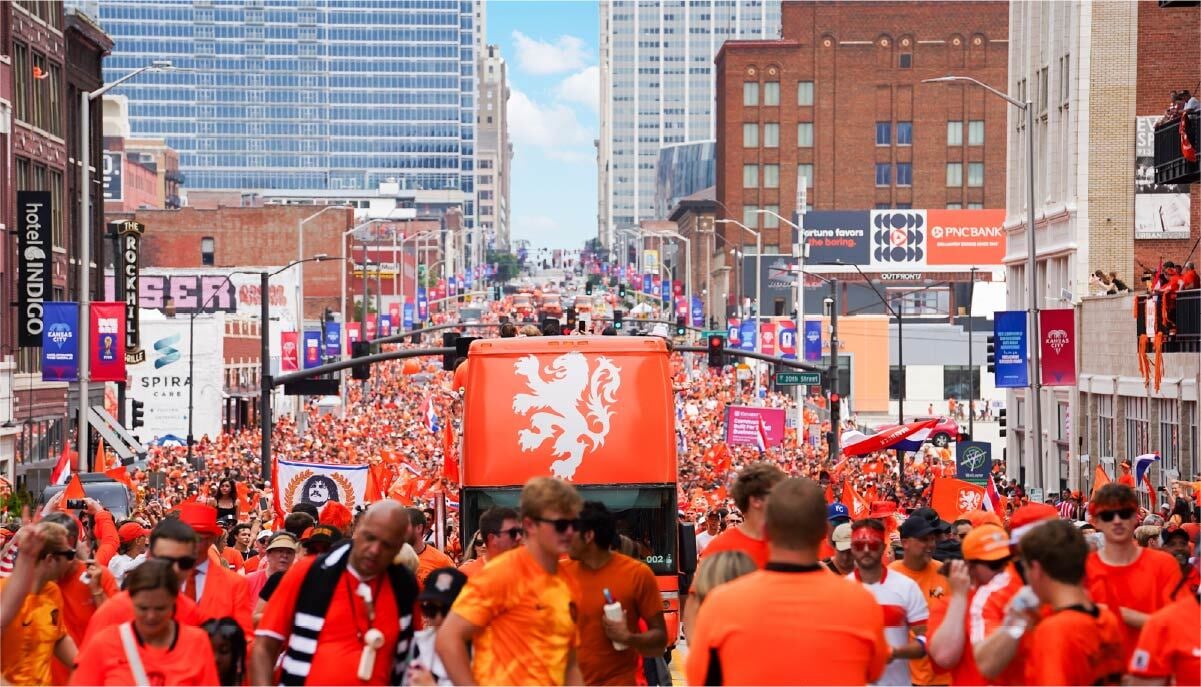
Oranje Walk

Photo: © 2026 KC2026. All Rights Reserved.*

Other activities, like the Netherlands’ iconic fan march through downtown Kansas City, were every bit as impactful though light-hearted. When 36,000 Dutch supporters launched their mile-long “Oranje Walk,” Jansen’s team was in the Joint Operations Center, helping KC2026, police and public works crews support the march. When the procession needed to slow down to coordinate with opening of the fan festival, the operations center radioed ahead to the lead orange bus.

“The Dutch had said early on that the orange bus would control the march: ‘If you need us to slow down, we will stop and do a dance!’ And that is exactly what happened.”

Meghan Jansen, Project Manager Project Manager

The team’s innovative approach extended to communications, developing a customized Fan Engagement Center to provide fast, consistent answers across multiple languages and channels. By blending human-in-the-loop oversight with AI-enabled workflows, this resource delivered rapid responses during critical moments, proving invaluable for managing fan experience, post-match crowd dispersals and regional weather updates.

The tournament serves as a real-life “stress test,” Jansen says, one showing that regional collaboration and temporary transit networks can overcome long-standing infrastructure gaps. While the temporary routes have concluded, the effort establishes a blueprint for future major events, turning Kansas City’s initial hurdle into a signature achievement.

Looking back, Jansen is grateful for it all: the tournament, the 17-hour days, and the challenges and opportunities that all grew out of a vision Kramer had outlined two years earlier during a meeting at Union Station.

“This is just one of those moments where you feel like you were in the right place at the right time,” she says.

*Photos: © 2026 KC2026. All Rights Reserved. FIFA World Cup 26™, FIFA World Cup™, World Cup™ and associated trademarks and logos are the property of FIFA.

Thought Leaders

Meghan Jansen

Project Communications & Outreach Manager

Burns & McDonnell

Julie Lorenz

Senior Managing Consultant

1898 & Co.

Contact Us  

Subscribe