Mission readiness depends on more than breakthrough technology. It depends on the facilities, utilities, production capacity and delivery teams that move capability from concept to deployment quickly.
The defining challenge facing the defense industrial base is no longer simply developing capability. It is scaling and fielding capability fast enough to meet strategic demand. Whether expanding missile production, modernizing infrastructure, increasing munitions capacity or standing up new manufacturing plants for next-generation systems, program success increasingly depends on accelerated deployment.
Geopolitical competition, growing demand for platforms and munitions, supply chain vulnerabilities and the need to strengthen domestic manufacturing capacity are forcing defense leaders to look beyond the traditional technology road map. The Department of Defense’s National Defense Industrial Strategy calls for an industrial base that can deliver at speed and scale while advancing four strategic priorities: resilient supply chains, workforce readiness, flexible acquisition and economic deterrence.
For installations, manufacturers and federal program leaders, that makes infrastructure delivery a strategic requirement. A utility service that cannot support new loads, a facility that cannot adapt to future production needs or a construction sequence that disrupts operations can delay training, production and deployment. In an era of strategic competition, those delays carry consequences beyond project schedules — many that can impact national security.
For decades, much of the industrial base was structured around predictable demand cycles and highly specialized production. Today’s environment requires a different level of responsiveness. Defense and federal teams must be able to expand capacity, reconfigure manufacturing environments and bring critical capability online faster without sacrificing quality, security or resilience.
Whether supporting a government installation or an original equipment manufacturer expanding production capacity, the challenge is the same: align infrastructure investment with mission demand. That alignment starts with an understanding of the physical systems that determine whether a program can move from approved need to operational capability quickly.
The Bottleneck Is Often Physical
In many modernization efforts, the greatest constraint is not the technology itself. It is the physical environment required to support it. Aerospace and defense facilities are being asked to produce more, accommodate advanced manufacturing technologies, operate under stricter security requirements and maintain greater energy resilience. Many sites were designed for a different production tempo and mission profile.
Power availability is emerging as one of the most significant challenges. A production line may be ready on paper, but if the service entrance, substation, central utility plant or backup power architecture can’t support the required load, schedules slip. Similar issues arise when aging installation infrastructure limits mission expansion or creates complex phasing requirements around ongoing operations.
Supply chain visibility creates additional risk. The Government Accountability Office reported in 2025 that DOD had made progress gathering supplier information for major subsystems and components, but visibility remained limited for a majority of suppliers, including those providing raw materials and parts.
These challenges are not new. What has changed is their strategic importance. Infrastructure constraints that once affected project timelines can now affect production targets, operational readiness and industrial surge capacity.
Across aerospace, defense and federal markets, successful programs address infrastructure risk with the same discipline and urgency applied to mission systems. The organizations that gain an advantage are often those that identify risks early. Utility constraints, permitting requirements, constructability challenges, interested-party alignment, regulatory approvals and long-lead procurement decisions all influence outcomes long before construction begins.
When teams identify constraints early, from utility capacity and equipment lead times to construction sequencing and commissioning requirements, they can protect the mission timeline before challenges become critical path issues.
From Program Delivery to Strategic Advantage
Speed-to-mission is often discussed in terms of acquisition and weapons systems. It should also be viewed as the ability to plan, design, permit, procure, construct and activate infrastructure that supports the mission on schedule.
Programs that align operational requirements, infrastructure planning and execution strategies early are better positioned to meet mission timelines. Programs that postpone key decisions frequently carry risk deeper into delivery, where options become more limited and more expensive.
The National Defense Industrial Association’s Vital Signs 2026 report reinforces this point, emphasizing that continued progress depends on translating strategy and investment into fielded capability on operationally relevant timelines.
Deterrence depends on visible and credible capacity. The ability to expand production, sustain operations and adapt faster than a competitor sends a powerful signal. Facilities, utilities and manufacturing systems are part of that equation.
Reducing Friction Through Early Alignment
Defense programs rarely suffer from a lack of interested parties. More often, they suffer from fragmented decision-making. Bringing planning, design, construction, procurement and commissioning perspectives together earlier helps expose constraints before they become schedule impacts. Teams can evaluate utility capacity, assess constructability, identify long-lead equipment requirements and determine how to maintain ongoing operations during construction.
We consistently see that the earliest decisions on delivery strategy, phasing, procurement and interested-party alignment have an outsized impact on a program’s ability to achieve success and schedule certainty. See Figure 1.
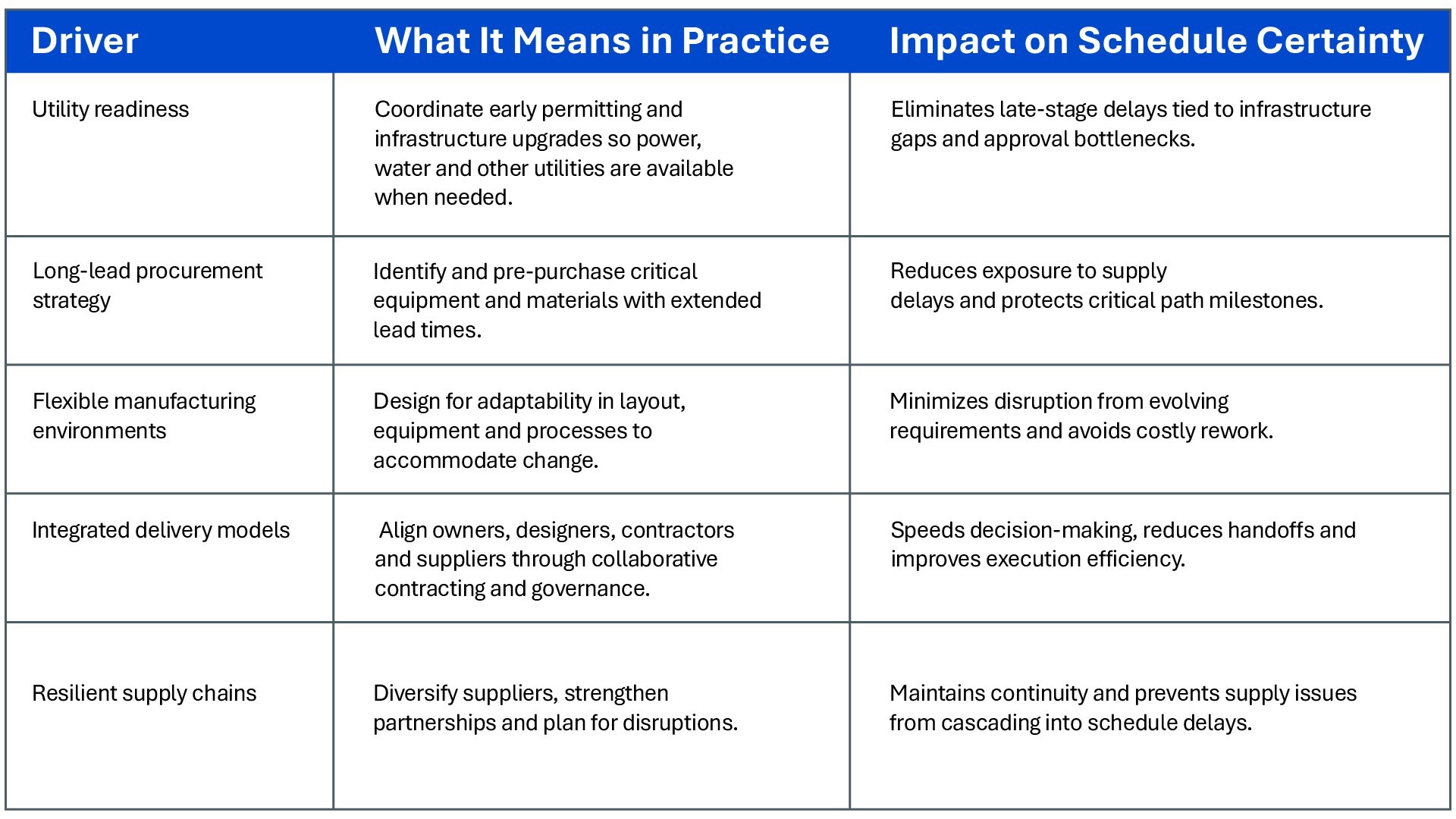
Figure 1. Key Speed-to-Mission Factors. The five critical drivers outlined in this chart work together to accelerate speed to mission, minimizing delays and enabling faster, more reliable delivery of mission-critical outcomes.
Traditional sequential delivery models can create handoffs at the exact moment programs need integration. Progressive design-build brings owners, designers, builders and critical trade partners together earlier, allowing teams to make informed decisions while they still have the greatest ability to influence cost and schedule.
The greatest benefit is not simply faster project delivery. It is greater confidence that mission-critical infrastructure will be ready when operational demand needs it.
Future-Ready Infrastructure Must Be Flexible and Resilient
The next generation of defense infrastructure must support changing missions, evolving technologies and uncertain operating environments.
Flexible manufacturing environments can accommodate new product mixes without major reconstruction. Modular utility systems allow facilities to expand capacity incrementally. Energy resilience strategies, including microgrids, onsite generation and battery energy storage systems, can reduce exposure to grid disruptions. Digital infrastructure can improve visibility into facility performance and maintenance needs.
These considerations are most effective when incorporated early. A facility designed only for current requirements may become tomorrow's constraint. Infrastructure planned for phased growth, resilience and adaptability can support multiple mission cycles while reducing future modernization costs.
Recent global events have reinforced the importance of production depth, energy security, supply chain transparency and allied coordination. These are no longer secondary considerations. They are essential components of readiness and industrial resilience.
Infrastructure Is Now a Strategic Asset
Execution has become a national security issue because infrastructure is where strategy becomes capacity.
Organizations that treat facilities, utilities and delivery models as strategic assets will be better positioned to support mission demands. They will identify schedule risk earlier, accelerate activation timelines and build infrastructure that can adapt as requirements evolve.
The defense programs most prepared for the next demand signal will be those that make infrastructure decisions with mission timing in mind. They will ask early whether power can be expanded, whether equipment can be procured on time, whether security protocols and environmental approvals can be sequenced without disruption and whether a facility can support a different product mix in the future.
Speed-to-mission is not simply about moving faster. It is about reducing friction between mission need and operational capability. For defense and federal leaders, that work begins long before the first system is deployed. It begins with the infrastructure that makes deployment possible.