Earlier this year, President Trump declared a national energy emergency, accelerating efforts to expedite permitting for domestic energy resources and critical minerals. The announcement aligns with growing concerns around capacity, reliability and capital planning across the grid — particularly as demand for electricity is projected to increase by 50% by 2050, according to the National Electrical Manufacturers Association.
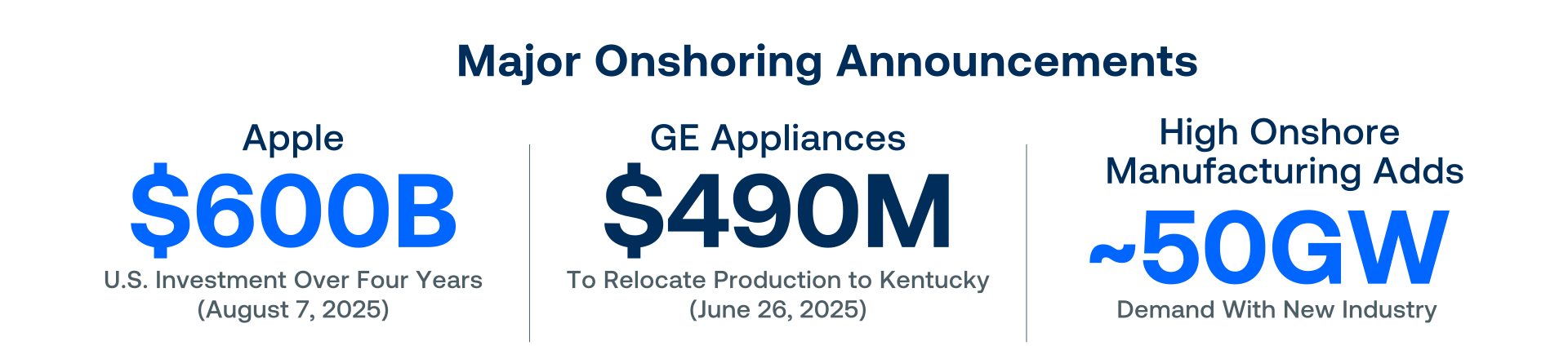
This demand surge, led by AI, data-centric facilities and onshoring of advanced manufacturing, has triggered a construction boom. It has also exposed critical gaps in power availability, water access and skilled labor. These pressures are reshaping how, where and what we build, and placing construction professionals at the forefront of some of the nation’s most urgent infrastructure challenges.
This is more than a U.S. story. Globally, electrical demand is doubling in many regions, and even as renewables grow, 80% of the world’s energy economy is still driven by fossil fuels, a number not expected to significantly change for decades.
Source: EPRI
According to Neva Espinoza, senior vice president and chief generation officer at EPRI, we’re entering a new era of urgency and scale: “Energy has always been evolving. But what’s different now is the pace — and the scale — of what’s being asked.”
She adds that rising demand, global instability and supply constraints are reframing the grid as a national imperative.
“There’s newfound respect for the importance of firm dispatchable energy and what that means for reliability moving forward,” Espinoza says. “With great power demand comes great opportunity — and a responsibility to get it right.”
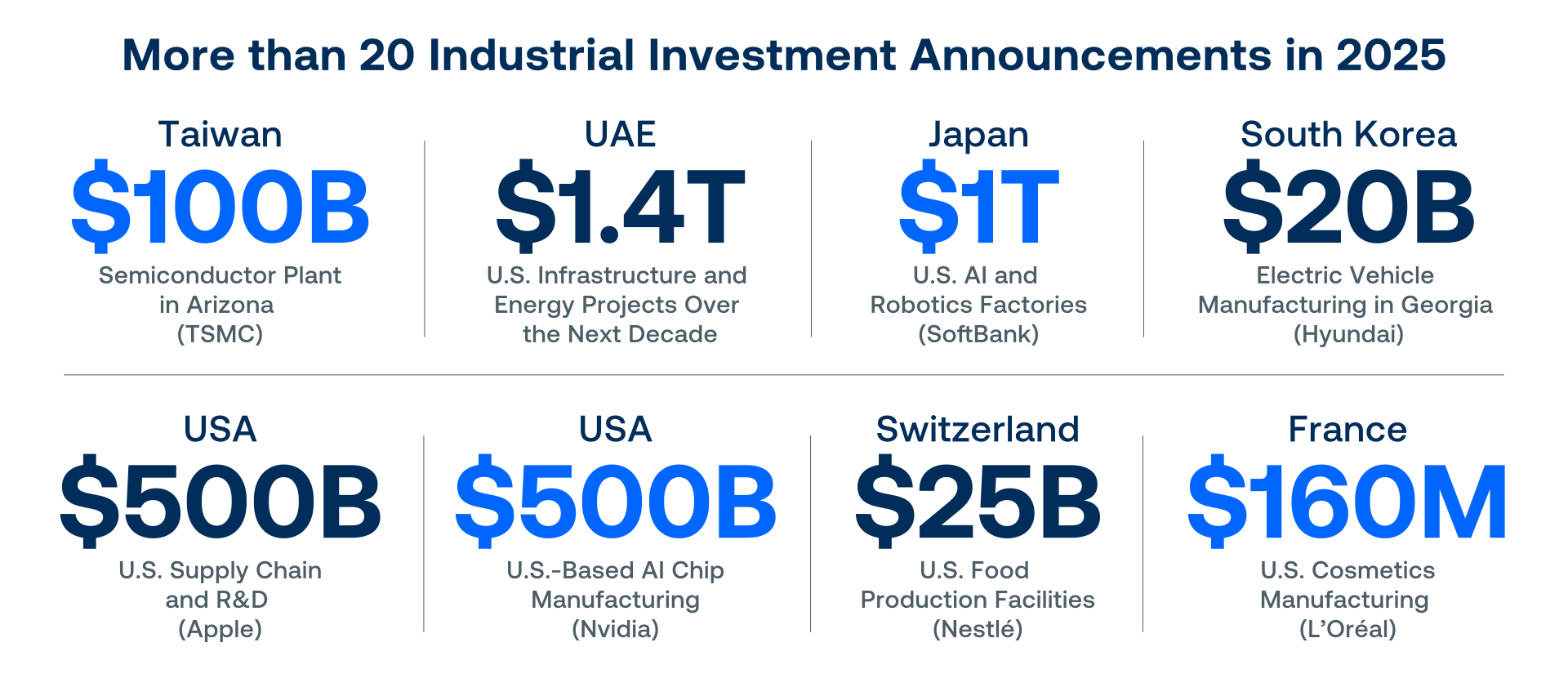
This sense of urgency is prompting substantial capital investments, with the U.S. power sector expected to see $1.4 trillion in investment between now and 2030. At the same time, the energy conversation is shifting from climate goals to energy security and energy dominance, putting construction delivery, infrastructure readiness and speed-to-power at the center of national strategy.
Source: EPRI
Power: It's Needed, and It's Needed Now
Grid capacity is no longer a given, with the grid struggling to meet demand, and interconnection timelines to approve new projects — with more than 2.6 terawatts of generation and storage capacity in the queue — taking anywhere from four to nine years to complete, in some instances. In response, developers are pursuing alternative solutions: privately owned substations, behind-the-meter generation and islanded microgrids designed for operation independent of interconnection timelines.
For construction teams, this shift expands the delivery scope to go beyond building facilities and into coordinating entire energy ecosystems. This means navigating utility interconnections, managing infrastructure upgrades and delivering systems that include generation, storage, gas and water services, and energy backup power — all while meeting aggressive timelines.
And while data-centric facilities vary in size and load, the trend toward high-performance computing is raising energy intensity across the board. Compared to traditional facilities, AI-enabled campuses are pushing toward multi-gigawatt footprints. Tech refresh cycles are also accelerating: hardware that once turned over every 10 to 15 years is now being replaced every three to five years, requiring construction teams to plan for more frequent upgrades and recurring mobilizations.
Meanwhile, major tech players are entering the energy space directly. Some are forming power partnerships — or signing 20-year power purchase agreements (PPAs) — to secure generation from nuclear, gas peaking and firm renewables. In many cases, these companies have never owned or operated energy assets before, creating new risk dynamics for construction and engineer-procure-construct (EPC) partners who are now expected to bring these systems online safely and quickly.
Espinoza emphasizes that while AI is driving demand, the responsibility of power generation — especially nuclear — must not be taken lightly. The nuclear journey will take some time, but reactors are currently being built in various parts of the country and beyond; China has recently built 24.
“The collective responsibility of nuclear energy cannot be lost,” she says. “Something that happens in the nuclear world anywhere impacts people everywhere.”
Water: A Critical Constraint and the Social License to Operate
While power makes headlines, water has emerged as an equally profound challenge and critical gating item for the digital economy. The massive cooling demand from large industrial facilities creates a significant business risk, but — more importantly — it creates a social and political challenge.
In an era of increasing water scarcity, a multibillion-dollar facility cannot simply connect to the local water main without impacting the supplies needed for community drinking water, fire protection and vital environmental ecosystems. This creates conflict that can delay permits, create public opposition and jeopardize the project's social license to operate.
This challenge becomes more complex as some campuses explore co-located “power islands” that combine on-site generation with energy-intensive operations. Even when facilities are designed for ultra-low water use, the energy required to support air-cooling systems can increase overall power demand.
The key issue is balance: understanding how cooling choices, site infrastructure and local water conditions interact, as well as planning for a water strategy that supports both the facility and the surrounding community. Successful developers will be those who engineer a water portfolio for the entire campus from day one. Key strategies include:
- Developing private water supplies from impaired sources, such as brackish groundwater or seawater that can be treated in dedicated desalination plants.
- Implementing closed-loop reuse systems across the campus to treat and recycle water, minimizing freshwater intake.
- Partnering with municipalities to use treated wastewater effluent for cooling, thereby preserving potable water for the community.
Ultimately, organizations that proactively invest in these water strategies are doing more than checking a box — they’re building long-term, operational resilience against regulatory restrictions, potential community opposition and resource constraints that will define the future of digital infrastructure. These early moves help protect future growth by reducing the risk that water availability becomes a limiting factor during the next drought or policy shift.
Policy Shifts: Changing the Rules of the Build
Federal policy is adding both momentum and uncertainty to the current market. According to Kate Marks, senior vice president at Venn Strategies, the current administration is relying heavily on executive orders and emergency powers to drive energy and infrastructure policy, often sidestepping traditional legislative processes in favor of rapid action on AI, data centers, fossil fuels and nuclear power.
One result: the launch of the Speed to Power Initiative from the U.S. Department of Energy, a campaign aimed at mapping project needs, accelerating permitting and removing grid-related bottlenecks for large-scale energy users. This program specifically targets data-intensive facilities and AI-fueled growth as a priority for infrastructure alignment and is backed by executive orders that fast-track data center infrastructure on federal lands and permitting for power generation and transmission. However, policy instability remains a major challenge. Programs initiated under the Biden administration have been paused, restructured or canceled. Early Trump executive actions halted or narrowed funding from the Infrastructure Investment and Jobs Act (IIJA) and the Inflation Reduction Act (IRA), and subsequent budget proposals and legislation have cut or reoriented several incentive programs. Litigation and follow-up guidance will now determine which tax credits, grants and loan programs survive in their original form, forcing developers and contractors to seek clarity on what support remains available.
Still, the long-term trends hold steady:
- Energy demand will continue to rise, driven in no small part by AI, data-intensive facilities and domestic manufacturing.
- The grid will require massive investment to keep pace and interconnect new high-demand loads.
- Policy will remain volatile, increasingly driven by fast-moving executive action rather than long-horizon legislation.
Construction teams should plan for continued regulatory swings and develop flexible delivery models that can respond to rapid shifts in permitting timelines, utility participation, and the mix of available federal funding opportunities favoring the build-out of AI data centers and related energy infrastructure.
Labor: The Bottleneck No One Can Ignore
Among immediate challenges facing the construction industry is the persistent shortage of skilled craft labor. As project complexity grows, so does the need for specialized trades — particularly electrical and mechanical, which are expected to remain the most constrained craft groups through 2029, according to new IIR data.
Nationwide labor demand is expected to continue increasing. While some regions, for now, remain relatively level, the Southwest faces steep deficits in mechanical crafts, such as for boilermakers and plumbers, while electrical availability is only slightly better. In the Midwest, Great Lakes and Mid-Atlantic regions, the shortage of electrical labor is even more pronounced than it is for mechanical, creating mounting pressure on high-voltage and energy infrastructure projects.
To attract skilled workers, some project sites are offering significantly elevated per diems, underscoring just how competitive the skilled labor market has become across trades, regions and project types. Additionally, project teams continue to invest in fabrication and modular assembly, where appropriate, to reduce site labor needs. Enhanced amenities and workforce support services are boosting retention, while early engagement with trade unions and technical programs is giving builders a critical edge.
In today’s energy-driven construction market, proactive labor planning has become a necessity, no longer a run-of-the-mill tactic.